Advertisements
Advertisements
Question
From the pictures given below, identity the actions that may cause inconvenience and discomfort to others. Discuss.
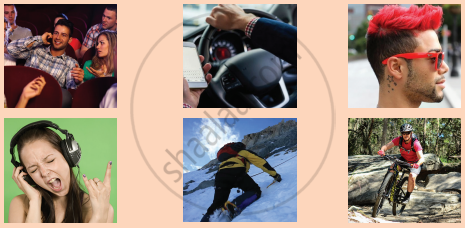
Advertisements
Solution
Using mobile phones, listening to loud music, and driving recklessly will cause inconvenience and discomfort to others.
APPEARS IN
RELATED QUESTIONS
Describe the appearance of Nicola and Jacopo.
Recount the untold sufferings undergone by the siblings after they were rendered homeless.
Justify the title of the story ‘Two Gentlemen of Verona’
Here are a few varieties of tea. How many of these have you tasted? Tick the boxes.

| Herbal Tea | |
| Ice Tea | |
| Lemon Tea | |
| Green Tea | |
| Black Tea | |
| Tea with Milk |
You would have seen lovely packets of tea on the shelves in supermarkets and shops. Have you ever wondered how tea powder is obtained from the plants? Look at the pictures and describe the process.
Which tea does the author prefer– China tea or Indian tea?
What is the second golden rule in the preparation of tea?
How does army tea taste?
Do tea lovers generally like strong tea or weak tea?
What should be poured into the cup first–tea or milk?
What thoughts troubled Dr. Christiaan Barnard as he neared the end of his career as a heart surgeon?
Who encouraged them and how?
Detail the statistics Dr. Barnard has provided in his speech.
Dr. Barnard couldn’t find any nobility in suffering. Why?
“These two children had given me a profound lesson …” Elucidate.
How did a casual incident in a hospital help Dr. Barnard perceive a new dimension of life?
Tick the qualities that are required to achieve such a feat.
| passion | reward | determination | physical |
| fame | faith | courage | money |
| drive | vengeance | inspiration | self-satisfaction |
| vision | undying spirit | inner-urge | perseverance |
What did Hillary do with his wet boots?
When did Hillary feel a sense of freedom and well being?
The soft snow was difficult and dangerous. Why?
How did Maamanaar handle the chair at home?
Define ‘liberty’ as perceived by the author.
What does the traffic policeman symbolize?
How would ‘liberty’ cause universal chaos?
What do you infer from Gardiner’s essay ‘On the rule of the Road'?
Para 19
neighbour Makalu, unexplored and
unclimbed. Far away across the clouds,
the great bulk of Kanchenjunga loomed
on the horizon. To the west, we could
see the great unexplored ranges of Nepal
stretching off into the distance.
Para 20
The most important photograph,
I felt, was a shot down the North Ridge,
showing the North Col and the old route
which had been made famous by the
struggles of those great climbers of the
1920’s and 1930’s. After ten minutes,
I realized that I was becoming rather
clumsy-fingered and slow-moving. So I
quickly replaced my oxygen set
Describe the view from the top. What was the most important photograph? (Para 19 and 20)
How responsible and capable are you at home?
