Advertisements
Advertisements
Question
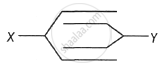
Four plates of equal area A are separated by equal distance d and are arranged as shown in Figure A. Their equivalent capacity is C1. Then, the same four plates are arranged as shown in Figure B, and their equivalent capacity is C2, then C1 : C2 is ______.
 |
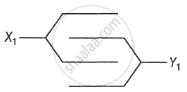 |
| Fig. A | Fig. B |
Options
3 : 4
2 : 3
3 : 2
4 : 3
Advertisements
Solution
Four plates of equal area A are separated by equal distance d and are arranged as shown in Figure A. Their equivalent capacity is C1. Then, the same four plates are arranged as shown in Figure B, and their equivalent capacity is C2, then C1 : C2 is 2 : 3.
Explanation:
Let X(1, 4) be a positive plate and Y(2, 3) be a negative plate.
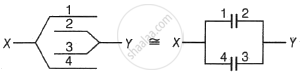
The equivalent capacitance is just a parallel combination of two capacitors, therefore,
`C_1 = (ε_0A)/d + (ε_0A)/d = (2ε_0A)/d`
Now,
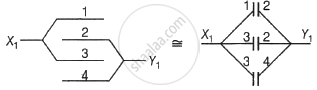
the equivalent capacitance is just a parallel combination of three capacitors. Therefore,
`C_2 = (ε_0A)/d + (ε_0A)/d + (ε_0A)/d = (3ε_0A)/d`
Therefore, `C_1/C_2 = 2/3`
