Advertisements
Advertisements
Question
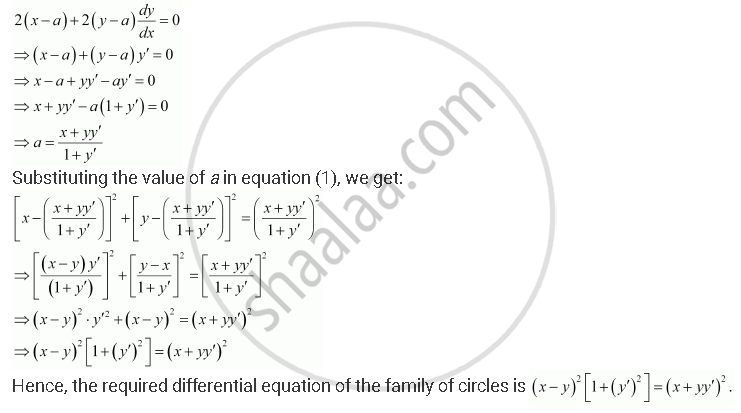
Form the differential equation of the family of circles in the first quadrant which touch the coordinate axes.
Advertisements
Solution
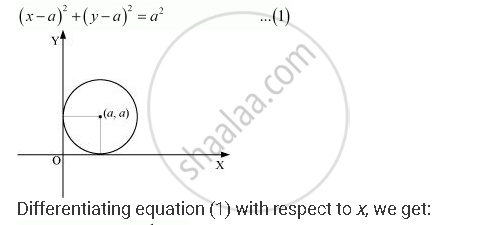
The equation of a circle in the first quadrant with centre (a, a) and radius (a) which touches the coordinate axes is:
APPEARS IN
RELATED QUESTIONS
Form the differential equation of the family of circles touching the y-axis at the origin.
Form the differential equation of the family of circles having centre on y-axis and radius 3 units.
Which of the following differential equations has y = c1 ex + c2 e–x as the general solution?
(A) `(d^2y)/(dx^2) + y = 0`
(B) `(d^2y)/(dx^2) - y = 0`
(C) `(d^2y)/(dx^2) + 1 = 0`
(D) `(d^2y)/(dx^2) - 1 = 0`
Show that the family of curves for which `dy/dx = (x^2+y^2)/(2x^2)` is given by x2 - y2 = cx
Form the differential equation corresponding to y = emx by eliminating m.
Form the differential equation from the following primitive where constants are arbitrary:
y = ax2 + bx + c
Find the differential equation of the family of curves y = Ae2x + Be−2x, where A and B are arbitrary constants.
Form the differential equation corresponding to (x − a)2 + (y − b)2 = r2 by eliminating a and b.
Form the differential equation of the family of curves represented by the equation (a being the parameter):
(2x + a)2 + y2 = a2
Form the differential equation of the family of curves represented by the equation (a being the parameter):
(2x − a)2 − y2 = a2
Represent the following families of curves by forming the corresponding differential equations (a, b being parameters):
y2 = 4ax
Represent the following families of curves by forming the corresponding differential equations (a, b being parameters):
x2 + (y − b)2 = 1
Represent the following families of curves by forming the corresponding differential equations (a, b being parameters):
(x − a)2 − y2 = 1
Represent the following families of curves by forming the corresponding differential equations (a, b being parameters):
y2 = 4a (x − b)
Find the equation of a curve passing through the point (0, 0) and whose differential equation is \[\frac{dy}{dx} = e^x \sin x\]
Find one-parameter families of solution curves of the following differential equation:-
\[\frac{dy}{dx} + 3y = e^{mx}\], m is a given real number.
Find one-parameter families of solution curves of the following differential equation:-
\[\frac{dy}{dx} - y = \cos 2x\]
Find one-parameter families of solution curves of the following differential equation:-
\[x\frac{dy}{dx} - y = \left( x + 1 \right) e^{- x}\]
Find one-parameter families of solution curves of the following differential equation:-
\[\frac{dy}{dx} - \frac{2xy}{1 + x^2} = x^2 + 2\]
Find one-parameter families of solution curves of the following differential equation:-
\[\frac{dy}{dx} + y \cos x = e^{\sin x} \cos x\]
Write the differential equation representing family of curves y = mx, where m is arbitrary constant.
Write the order of the differential equation representing the family of curves y = ax + a3.
The family of curves in which the sub tangent at any point of a curve is double the abscissae, is given by
Form the differential equation representing the family of curves `y2 = m(a2 - x2) by eliminating the arbitrary constants 'm' and 'a'.
Find the differential equation of the family of curves y = Ae2x + B.e–2x.
The solution of the differential equation `2x * "dy"/"dx" y` = 3 represents a family of ______.
Form the differential equation of all circles which pass through origin and whose centres lie on y-axis.
Find the equation of a curve passing through origin and satisfying the differential equation `(1 + x^2) "dy"/"dx" + 2xy` = 4x2
Form the differential equation by eliminating A and B in Ax2 + By2 = 1
Find the equation of a curve passing through (2, 1) if the slope of the tangent to the curve at any point (x, y) is `(x^2 + y^2)/(2xy)`.
Find the equation of a curve passing through the point (1, 1). If the tangent drawn at any point P(x, y) on the curve meets the co-ordinate axes at A and B such that P is the mid-point of AB.
The differential equation `y ("d"y)/("d"x) + "c"` represents: ______.
The curve for which the slope of the tangent at any point is equal to the ratio of the abcissa to the ordinate of the point is ______.
The differential equation of the family of curves y2 = 4a(x + a) is ______.
Find the equation of the curve at every point of which the tangent line has a slope of 2x:
Form the differential equation of family of circles having centre on y-axis and raduis 3 units
