Advertisements
Advertisements
Question
(For this question, use a graph paper. Scale: 1 cm = 1 unit along both x and y-axis.)
Plot points A(0, 3), B(4, 0), C(6, 2) and D(5, 0). Reflect the points as given below and write their coordinates:
- Reflect A on x-axis to A’.
- Reflect B on y-axis to B’.
- Reflect C on x-axis to C’.
- D remain invariant when reflected on the line whose equation is ______.
- Join the points A, B, C, D, C’, B, A’, B’ and A to form a closed figure. Name the closed figure BCDC’.
Advertisements
Solution
1. Reflected coordinates
The coordinates for the reflected points are found by changing the sign of the axis opposite to the reflection line:
a. Reflect A(0, 3) on x-axis: A’(0, –3). The y-coordinate changes sign.
b. Reflect B(4, 0) on y-axis: B’(–4, 0). The x-coordinate changes sign.
c. Reflect C(6, 2) on x-axis: C’(6, –2). The y-coordinate changes sign.
2. Invariant point
d. Point D(5, 0) remains invariant when reflected on the line whose equation is y = 0 the x-axis. This is because the point already lies on this line, so its position does not change during reflection.
3. Forming the closed figure
e. Joining the points in the order A → B → C → D → C’ → B → A’ → B’ → A creates a complex closed figure.
Name the closed figure BCDC': Based on the points B(4, 0), C(6, 2), D(5, 0), and C’(6, –2), the figure BCDC’ is a kite (specifically, a concave one or a “dart” shape) symmetric about the x-axis.
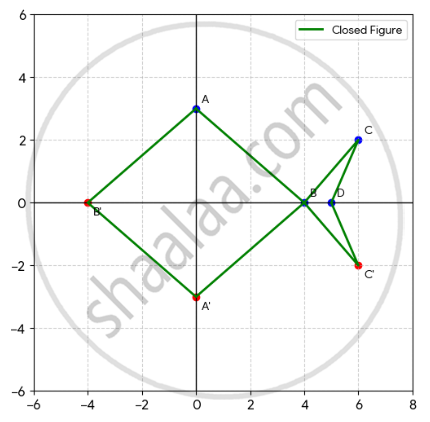
The coordinates are A’(0, –3), B’(–4, 0) and C’(6, –2). The line of invariance for D is y = 0.
