Advertisements
Advertisements
Question
For each of the following statements state whether true(T) or false (F)
The sum of the squares on the sides of a rhombus is equal to the sum of the squares on its diagonals.
Advertisements
Solution
True
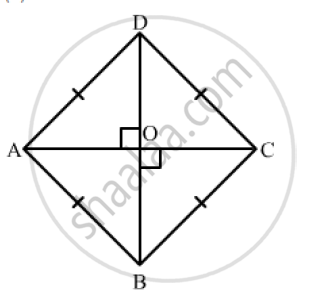
Suppose ABCD is a rhombus having AC and BD its diagonals.
Since, the diagonals of a rhombus perpendicular bisect each other.
Hence, AOC is a right angle triangle
In right triangle AOC
By using Pythagoras theorem, we have
`AB^2=((AC)/2)^2+((BD)/2)^2`
[∴ Diagonals of a rhombus perpendicularly bisect each other]
⇒ `AB^2=((AC)/2)^2+((BD)/2)^2`
⇒ `4AB^2=AC^2+BD^2`
⇒ `AB^2+AB^2+AB^2+AB^2=AC^2+BD^2`
⇒ `AB^2+BC^2+CD^2+DA^2=AC^2+BD^2` [∵𝐴𝑙𝑙 𝑠𝑖𝑑𝑒𝑠 𝑜𝑓 𝑎 𝑟ℎ𝑜𝑚𝑏𝑢𝑠 𝑎𝑟𝑒 𝑒𝑞𝑢𝑎𝑙]
shaalaa.com
Is there an error in this question or solution?
