Advertisements
Advertisements
Question
For the curve y = 4x3 − 2x5, find all the points at which the tangents passes through the origin.
Advertisements
Solution
The equation of the given curve is y = 4x3 − 2x5.
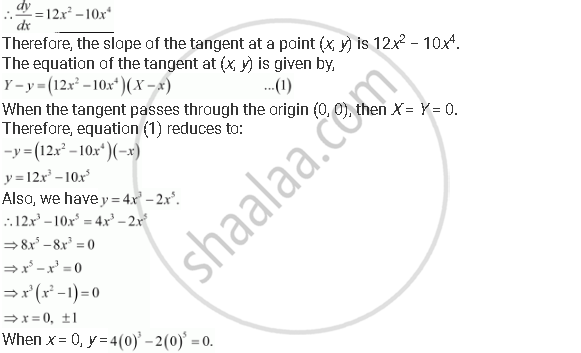
When x = 1, y = 4 (1)3 − 2 (1)5 = 2.
When x = −1, y = 4 (−1)3 − 2 (−1)5 = −2.
Hence, the required points are (0, 0), (1, 2), and (−1, −2).
APPEARS IN
RELATED QUESTIONS
The equation of tangent at (2, 3) on the curve y2 = ax3 + b is y = 4x – 5. Find the values of a and b.
Prove that the least perimeter of an isosceles triangle in which a circle of radius r can be inscribed is `6sqrt3` r.
Find the slope of the tangent to the curve y = 3x4 − 4x at x = 4.
Find the equation of all lines having slope 2 which are tangents to the curve `y = 1/(x- 3), x != 3`
Find the equations of all lines having slope 0 which are tangent to the curve y = `1/(x^2-2x + 3)`
Find points on the curve `x^2/9 + "y"^2/16 = 1` at which the tangent is parallel to x-axis.
Find the slope of the tangent and the normal to the following curve at the indicted point \[y = \sqrt{x} \text { at }x = 9\] ?
Find the slope of the tangent and the normal to the following curve at the indicted point x = a (θ − sin θ), y = a(1 − cos θ) at θ = −π/2 ?
Find the slope of the tangent and the normal to the following curve at the indicted point xy = 6 at (1, 6) ?
At what points on the curve y = x2 − 4x + 5 is the tangent perpendicular to the line 2y + x = 7?
Find the points on the curve\[\frac{x^2}{4} + \frac{y^2}{25} = 1\] at which the tangent is parallel to the y-axis ?
Find the points on the curve \[\frac{x^2}{9} + \frac{y^2}{16} = 1\] at which the tangent is parallel to x-axis ?
Find the equation of the tangent and the normal to the following curve at the indicated point y = x4 − 6x3 + 13x2 − 10x + 5 at x = 1?
Find the equation of the tangent and the normal to the following curve at the indicated point y = 2x2 − 3x − 1 at (1, −2) ?
Find the equation of the tangent and the normal to the following curve at the indicated points \[x = \frac{2 a t^2}{1 + t^2}, y = \frac{2 a t^3}{1 + t^2}\text { at } t = \frac{1}{2}\] ?
Find the equation of the tangent and the normal to the following curve at the indicated points x = a(θ + sinθ), y = a(1 − cosθ) at θ ?
Find the equation of the normal to the curve x2 + 2y2 − 4x − 6y + 8 = 0 at the point whose abscissa is 2 ?
Find the equation of a normal to the curve y = x loge x which is parallel to the line 2x − 2y + 3 = 0 ?
Prove that the curves xy = 4 and x2 + y2 = 8 touch each other ?
Prove that the curves y2 = 4x and x2 + y2 - 6x + 1 = 0 touch each other at the point (1, 2) ?
If the tangent line at a point (x, y) on the curve y = f(x) is parallel to x-axis, then write the value of \[\frac{dy}{dx}\] ?
Write the value of \[\frac{dy}{dx}\] , if the normal to the curve y = f(x) at (x, y) is parallel to y-axis ?
Write the angle made by the tangent to the curve x = et cos t, y = et sin t at \[t = \frac{\pi}{4}\] with the x-axis ?
Write the slope of the normal to the curve \[y = \frac{1}{x}\] at the point \[\left( 3, \frac{1}{3} \right)\] ?
The equations of tangent at those points where the curve y = x2 − 3x + 2 meets x-axis are _______________ .
The angle of intersection of the curves y = 2 sin2 x and y = cos 2 x at \[x = \frac{\pi}{6}\] is ____________ .
The normal to the curve x2 = 4y passing through (1, 2) is _____________ .
Find the equation of the tangent line to the curve `"y" = sqrt(5"x" -3) -5`, which is parallel to the line `4"x" - 2"y" + 5 = 0`.
The point on the curve y2 = x, where the tangent makes an angle of `pi/4` with x-axis is ______.
At (0, 0) the curve y = x3 + x
`"sin"^"p" theta "cos"^"q" theta` attains a maximum, when `theta` = ____________.
The two curves x3 - 3xy2 + 5 = 0 and 3x2y - y3 - 7 = 0
The tangent to the curve y = 2x2 - x + 1 is parallel to the line y = 3x + 9 at the point ____________.
The points at which the tangent passes through the origin for the curve y = 4x3 – 2x5 are
The normal at the point (1, 1) on the curve `2y + x^2` = 3 is
The curve `(x/a)^n + (y/b)^n` = 2, touches the line `x/a + y/b` = 2 at the point (a, b) for n is equal to ______.
The normals to the curve x = a(θ + sinθ), y = a(1 – cosθ) at the points θ = (2n + 1)π, n∈I are all ______.
