Advertisements
Advertisements
Question
Find the point of intersection of the line `vecr = (3hati + hatk) + μ(hati + hatj + hatk)` and the line through (2, –1, 1) parallel to the z-axis. How far is this point from the z-axis?
Advertisements
Solution
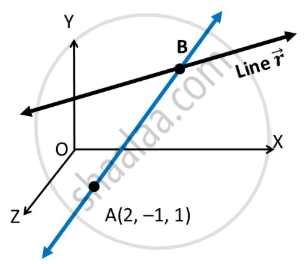
Let Point A be (2, −1, 1).
Let point B be the point on line `vecr` such that AB is parallel to the z-axis.
Equation of line is `vecr = (3hati + hatk) + μ(hati + hatj + hatk)`
Now, point B is the point of intersection of line `vecr = (3hati + hatk) + μ(hati + hatj + hatk)` and the line through (2, −1, 1). parallel to the z-axis.
Finding Point B:
Since point B lies on line `vecr`.
Now,
`vecr = (3hati + hatk) + μ(hati + hatj + hatk)`
`vecr = 3hati + hatk + μhati + μhatj + μhatk`
`vecr = (3 + μ)hati + μhatj + (1 + μ) hatk`
So, x = 3 + μ
y = μ
z = 1 + μ
∴ B = (3 + μ, μ, 1 + μ)
Since AB is parallel to the z-axis.
Their direction cosines would be equal.
Direction cosines of the z-axis are:
I = cos 90° = 0
m = cos 90° = 0
n = cos 0° = 1
∴ Direction cosines of the z-axis are 0, 0, 1.
Direction cosines of AB:
For A(2, −1, 1) and B(3 + μ, μ, 1 + μ)
Direction ratios of AB:
⇒ 3 + μ − 2
= 1 + μ
⇒ μ − (−1)
= μ + 1
⇒ 1 + μ − 1
= μ
Direction cosines of AB = `(1 + μ)/(AB), (1 + μ)/(AB), μ/(AB)`
Since AB and the z-axis are parallel.
Both sets of direction cosines are equal.
Equating x-component:
`(1 + μ)/(AB) = 0`
1 + μ = 0
μ = −1
Thus, point B becomes:
x = 3 + μ
= 3 − 1
= 2
y = μ = −1
z = 1 + μ
= 1 + (−1)
= 0
∴ B = (2, −1, 0)
Thus, the required point B is (2, −1, 0).
Now, we need to find distance between B(2, −1, 0) and z-axis.
Distance of B (x, y, z) and z-axis = `sqrt(x^2 + y^2)`
= `sqrt(2^2 + (-1)^2)`
= `sqrt(4 + 1)`
= `sqrt5` units
