Advertisements
Advertisements
Questions
Find the number of atoms in the fcc unit cell.
Calculate the number of particles per unit cell in a face-centred cubic system.
In a face centred arrangement of atoms of an element, what will be the number of atoms present in respective unit cells?
Advertisements
Solution
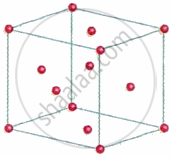
A face-centred cubic (fcc) unit cell has particles at the eight corners plus particles at the centre of its six faces.
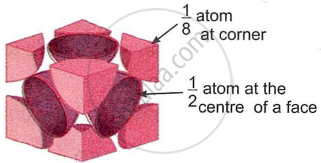
Each particle present at the corner of a given unit cell is shared with seven other neighbouring unit cells. As a result, its contribution to the given unit cell is only `1/8`.
Thus, the number of particles present at corners per unit cell
= 8 corner atoms × `1/8` atom per unit cell = 1
Each particle at the centre of the six faces is shared with one neighbouring cube. Thus, 1/2 of each face particle belongs to the given unit cell. Thus, the number of particles present at faces per unit cell
= 6 atoms at the faces × `1/2` atom per unit cell = 3
Therefore, fcc unit cell has one corner particle plus 3 face particles, making a total of 4 particles per unit cell.
APPEARS IN
RELATED QUESTIONS
Answer the following in brief.
Calculate the number of atoms in fcc unit cell.
Give the percentage of empty space in bcc lattice.
The pyranose structure of glucose is ____________.
An element crystallizes in fcc type of unit cell. The volume of one unit cell is 24.99 × 10⁻²⁴ cm3 and density of the element 7.2 g cm-3, Calculate the number of unit cells in 36 g of pure sample of element?
What is the percentage of unoccupied space in fcc unit cell?
In bcc unit cell, the edge length (a) and radius of sphere (r) are related to each other by equation:
How many total constituent particles are present in simple cubic unit cell?
The percentage of unoccupied volume in simple cubic cell is ______.
The number of atoms in 500 g of a fcc crystal of a metal with density d = 10 g/cm3 and cell edge 100 pm, is equal to ____________.
An element crystallizes bcc type of unit cell, the density and edge length of unit cell is 4 g cm−3 and 500 pm respectively. What is the atomic mass of an element?
Copper and silver have ____________ crystal structure.
A metallic element has a cubic lattice with edge length of unit cell 2 Å. Calculate the number of unit cells in 200 g of the metal, if density of metal is 2.5 g cm-3?
Which of the following formulae is used to find edge length of bee unit cell?
A metal has an fcc lattice. The edge length of the unit cell is 404 pm. The density of the metal is 2.72 g cm−3. The molar mass of the metal is ______.
(NA Avogadro's constant = 6.02 × 10²³ mol−1)
In face centred cubic unit cell, what is the volume occupied?
Calculate the density of metal with molar mass 56 g mol- 1 that crystallises to form a bcc structure with edge length 288 pm.
Identify unit cell from following having four particles in it
The total number of different primitive unit cells is ______.
What would be the empirical formula of a compound having a unit cell containing A ion shared equally at the corner of the cube and B ion on the centre of faces of the cube?
An element crystallises in fee structure. If molar mass of element is 72.7 g mol -1, the mass of its one unit cell will be ______.
Which of the following metals exhibits minimum packing efficiency in its cubic system?
The cubic unit cell of a metal (molar mass = 63.55g mol−1) has an edge length of 362 pm. Its density is 8.92g cm−3.
The type of unit cell is ______.
Calculate the molar mass of an element having density 2.8 g cm−3 and forms fcc unit cell.
[a3.NA = 38.5 cm3 mol−1]
