Advertisements
Advertisements
Question
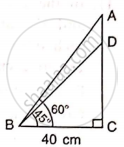
Find the length of AD.
Given: ∠ABC = 60o.
∠DBC = 45o
and BC = 40 cm.
Advertisements
Solution
From right triangle ABC,
tan 60° = `"AC"/"BC"`
⇒ `sqrt(3) = "AC"/40`
⇒ AC = `40sqrt(3)"cm"`
From right triangle BDC,
tan 45° = `"DC"/"BC"`
⇒ 1 = `"DC"/(40)`
⇒ DC = 40 cm
From the figure, it is clear that AD = AC - DC
⇒ AD = `40sqrt(3) - 40`
⇒ AD = `40(sqrt3 - 1)`
⇒ AD = 29.28 cm
APPEARS IN
RELATED QUESTIONS
Find angle 'A' if :
Find the lengths of diagonals AC and BD. Given AB = 60 cm and ∠ BAD = 60°.

In trapezium ABCD, as shown, AB // DC, AD = DC = BC = 20 cm and ∠ A = 60°. Find: length of AB

In trapezium ABCD, as shown, AB // DC, AD = DC = BC = 20 cm and A = 60°. Find: distance between AB and DC.

Use the information given to find the length of AB.

In the given figure, AB and EC are parallel to each other. Sides AD and BC are 2 cm each and are perpendicular to AB.

Given that ∠AED = 60° and ∠ACD = 45°. Calculate: AC
In the given figure, AB and EC are parallel to each other. Sides AD and BC are 2 cm each and are perpendicular to AB.

Given that ∠ AED = 60° and ∠ ACD = 45°. Calculate: AE.
In right-angled triangle ABC; ∠ B = 90°. Find the magnitude of angle A, if: AB is √3 times of BC.
A ladder is placed against a vertical tower. If the ladder makes an angle of 30° with the ground and reaches upto a height of 15 m of the tower; find length of the ladder.
The perimeter of a rhombus is 96 cm and obtuse angle of it is 120°. Find the lengths of its diagonals.
