Advertisements
Advertisements
Question
Find the equation of the ellipse in the case:
focus is (−2, 3), directrix is 2x + 3y + 4 = 0 and e = \[\frac{4}{5}\]
Advertisements
Solution
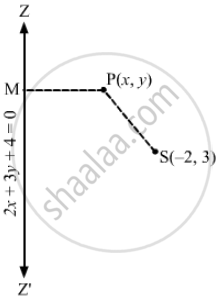
\[\text{ Let S( - 2, 3) be the focus and ZZ' be the directrix . } \]
\[\text{ Let P(x, y) be any point on the ellipse and let PM be the perpendicular from P on the directrix } . \]
\[\text{ Then by the definition, we have: } \]
\[SP = e \times PM\]
\[ \Rightarrow SP = \frac{4}{5} \times PM\]
\[ \Rightarrow \frac{5}{4}SP = PM\]
\[ \Rightarrow \frac{25}{16} \left( SP \right)^2 = {PM}^2 \]
\[ \Rightarrow \frac{25}{16}\left[ \left( x + 2 \right)^2 + \left( y - 3 \right)^2 \right] = \left| \frac{2x + 3y + 4}{\sqrt{2^2 + 3^2}} \right|^2 \]
\[ \Rightarrow \frac{25}{16}\left[ x^2 + 4 + 4x + y^2 + 9 - 6y \right] = \frac{4 x^2 + 9 y^2 + 16 + 12xy + 24y + 16x}{13}\]
\[ \Rightarrow 325\left( x^2 + 4 + 4x + y^2 + 9 - 6y \right) = 16\left( 4 x^2 + 9 y^2 + 16 + 12xy + 24y + 16x \right)\]
\[ \Rightarrow 325 x^2 + 1300 + 1300x + 325 y^2 + 2925 - 1950y = 64 x^2 + 144 y^2 + 256 + 192xy + 384y + 256x\]
\[ \Rightarrow 261 x^2 + 181 y^2 + 1044x - 2309y - 192xy + 3969 = 0\]
\[\text{ This is the required equation of the ellipse } .\]
APPEARS IN
RELATED QUESTIONS
Find the equation for the ellipse that satisfies the given condition:
Vertices (±5, 0), foci (±4, 0)
Find the equation for the ellipse that satisfies the given conditions:
Vertices (0, ±13), foci (0, ±5)
Find the equation for the ellipse that satisfies the given conditions:
Vertices (±6, 0), foci (±4, 0)
Find the equation for the ellipse that satisfies the given conditions:
Ends of major axis (±3, 0), ends of minor axis (0, ±2)
Find the equation for the ellipse that satisfies the given conditions:
Ends of major axis (0, `+- sqrt5`), ends of minor axis (±1, 0)
Find the equation for the ellipse that satisfies the given conditions:
Length of minor axis 16, foci (0, ±6)
Find the equation for the ellipse that satisfies the given conditions:
Major axis on the x-axis and passes through the points (4, 3) and (6, 2).
Find the equation of the ellipse in the case:
focus is (0, 1), directrix is x + y = 0 and e = \[\frac{1}{2}\] .
Find the equation of the ellipse in the case:
focus is (−1, 1), directrix is x − y + 3 = 0 and e = \[\frac{1}{2}\]
Find the equation of the ellipse in the case:
eccentricity e = \[\frac{1}{2}\] and foci (± 2, 0)
Find the equation of the ellipse in the case:
eccentricity e = \[\frac{2}{3}\] and length of latus rectum = 5
Find the equation of the ellipse in the case:
eccentricity e = \[\frac{1}{2}\] and semi-major axis = 4
Find the equation of the ellipse in the case:
The ellipse passes through (1, 4) and (−6, 1).
Find the equation of the ellipse in the case:
Vertices (± 5, 0), foci (± 4, 0)
Find the equation of the ellipse in the case:
Vertices (0, ± 13), foci (0, ± 5)
Find the equation of the ellipse in the following case:
Vertices (± 6, 0), foci (± 4, 0)
Find the equation of the ellipse in the following case:
Ends of major axis (± 3, 0), ends of minor axis (0, ± 2)
Find the equation of the ellipse in the following case:
Ends of major axis (0, ±\[\sqrt{5}\] ends of minor axis (± 1, 0)
Find the equation of the ellipse in the following case:
Length of major axis 26, foci (± 5, 0)
Find the equation of the ellipse in the following case:
Length of minor axis 16 foci (0, ± 6)
A bar of given length moves with its extremities on two fixed straight lines at right angles. Any point of the bar describes an ellipse.
Find the equation of ellipse whose eccentricity is `2/3`, latus rectum is 5 and the centre is (0, 0).
If P is a point on the ellipse `x^2/16 + y^2/25` = 1 whose foci are S and S′, then PS + PS′ = 8.
The equation of the ellipse having foci (0, 1), (0, –1) and minor axis of length 1 is ______.
