Advertisements
Advertisements
Question
Find the area of the region \[\left\{ \left( x, y \right): \frac{x^2}{a^2} + \frac{y^2}{b^2} \leq 1 \leq \frac{x}{a} + \frac{y}{b} \right\}\]
Advertisements
Solution
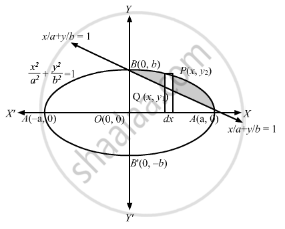
\[\text{ Let }R = \left\{ \left( x, y \right) : \frac{x^2}{a^2} + \frac{y^2}{b^2} \leq 1 \leq \frac{x}{a} + \frac{y}{b} \right\}\]
\[ \Rightarrow R_1 = \left\{ \left( x, y \right) : \frac{x^2}{a^2} + \frac{y^2}{b^2} \leq 1 \right\}\]
\[\text{ and }R_{2 =} \left\{ \left( x, y \right) : 1 \leq \frac{x}{a} + \frac{y}{b} \right\}\]
Then,
\[R = R_1 \cap R_2 \]
\[\text{ Consider }\frac{x^2}{a^2} + \frac{y^2}{b^2} = 1 . \text{ This represents an ellipse, symmetrical about both axis and cutting }x - \text{ axis at A(a, 0) and A'( - a, 0) and }y - \text{ axis at B(0, b), B'(0, - b)}\]
\[ \Rightarrow R_1 = \left( \frac{x^2}{a^2} + \frac{y^2}{b^2} \leq 1 \right)\text{ represents the area inside the ellipse }\]
\[\frac{x}{a} + \frac{y}{b} = 1 = \text{ represents a straight line cutting }x - \text{ axis at A(a, 0) and }y - \text{ axis at B(0, b)}\]
\[ \Rightarrow R_2 = \left( \frac{x}{a} + \frac{y}{b} \geq 1 \right)\text{ represents the area above the straight line }\]
\[ \Rightarrow R = R_1 \cap R_2\text{ represents the smaller shaded area bounded by the line and the ellipse }\]
\[\text{ In the shaded region, consider a vertical strip with length }= \left| y_2 - y_1 \right|\text{ and width = dx, such that }P(x, y_2 ) \text{ lies on ellipse and }Q(x, y_1 )\text{ lies on the straight line }\]
\[\text{ Area of approximating rectangle }= \left| y_2 - y_1 \right| dx \]
\[\text{ The approximating rectangle moves from }x = 0\text{ to }x = a\]
\[ \therefore \text{ Area of the shaded region }= \int_0^a \left| y_2 - y_1 \right| dx = \int_0^a \left( y_2 - y_1 \right) dx ..................\left[ As, y_2 > y_1 , \left| y_2 - y_1 \right| = y_2 - y_1 \right] \]
\[ \Rightarrow A = \int_0^a \left( \frac{b}{a}\sqrt{a^2 - x^2} - \frac{b}{a}\left( a - x \right) \right) dx\]
\[ \Rightarrow A = \int_0^a \left( \frac{b}{a}\sqrt{a^2 - x^2} \right)dx - \int_0^a \frac{b}{a}\left( a - x \right) dx\]
\[ \Rightarrow A = \frac{b}{a} \left[ \left\{ \frac{x}{2}\sqrt{a^2 - x^2} + \frac{1}{2} a^2 \sin^{- 1} \left( \frac{x}{a} \right) \right\} \right]_0^a - \frac{b}{a}\left[ ax - \frac{x^2}{2} \right]\]
\[ \Rightarrow A = \frac{b}{a}\left[ 0 + \frac{1}{2} a^2 \sin^{- 1} 1 - \left( a^2 - \frac{a^2}{2} \right) \right]\]
\[ \Rightarrow A = \frac{b}{a}\left[ \frac{1}{2} a^2 \times \frac{\pi}{2} - \frac{a^2}{2} \right]\]
\[ \Rightarrow A = \frac{ab}{2}\left[ \frac{\pi}{2} - 1 \right]\]
\[ \Rightarrow A = \frac{ab}{4}\left[ \pi - 2 \right]\text{ sq . units } \]
APPEARS IN
RELATED QUESTIONS
triangle bounded by the lines y = 0, y = x and x = 4 is revolved about the X-axis. Find the volume of the solid of revolution.
Prove that the curves y2 = 4x and x2 = 4y divide the area of square bounded by x = 0, x = 4, y = 4 and y = 0 into three equal parts.
Find the area of the region lying in the first quandrant bounded by the curve y2= 4x, X axis and the lines x = 1, x = 4
Find the equation of a curve passing through the point (0, 2), given that the sum of the coordinates of any point on the curve exceeds the slope of the tangent to the curve at that point by 5
Draw a rough sketch of the graph of the curve \[\frac{x^2}{4} + \frac{y^2}{9} = 1\] and evaluate the area of the region under the curve and above the x-axis.
Draw a rough sketch of the graph of the function y = 2 \[\sqrt{1 - x^2}\] , x ∈ [0, 1] and evaluate the area enclosed between the curve and the x-axis.
Using integration, find the area of the region bounded by the following curves, after making a rough sketch: y = 1 + | x + 1 |, x = −2, x = 3, y = 0.
Sketch the graph y = |x + 1|. Evaluate\[\int\limits_{- 4}^2 \left| x + 1 \right| dx\]. What does the value of this integral represent on the graph?
Draw a rough sketch of the curve y = \[\frac{\pi}{2} + 2 \sin^2 x\] and find the area between x-axis, the curve and the ordinates x = 0, x = π.
Find the area enclosed by the curve x = 3cost, y = 2sin t.
Find the area of the region bounded by x2 = 16y, y = 1, y = 4 and the y-axis in the first quadrant.
Find the area of the region bounded by y =\[\sqrt{x}\] and y = x.
Find the area bounded by the curves x = y2 and x = 3 − 2y2.
Find the area of the region in the first quadrant enclosed by the x-axis, the line y = x and the circle x2 + y2= 32.
Find the area of the region bounded by the curve y = \[\sqrt{1 - x^2}\], line y = x and the positive x-axis.
Find the area of the region {(x, y): x2 + y2 ≤ 4, x + y ≥ 2}.
Find the area enclosed by the curves 3x2 + 5y = 32 and y = | x − 2 |.
Find the area of the figure bounded by the curves y = | x − 1 | and y = 3 −| x |.
The area bounded by the curve y = loge x and x-axis and the straight line x = e is ___________ .
The area bounded by the parabola x = 4 − y2 and y-axis, in square units, is ____________ .
The area of the region bounded by the parabola (y − 2)2 = x − 1, the tangent to it at the point with the ordinate 3 and the x-axis is _________ .
The area of the region (in square units) bounded by the curve x2 = 4y, line x = 2 and x-axis is
The area bounded by the curve y2 = 8x and x2 = 8y is ___________ .
The area of the circle x2 + y2 = 16 enterior to the parabola y2 = 6x is
Find the area of the region bounded by the parabola y2 = 2x and the straight line x – y = 4.
Find the area of the region bounded by the parabolas y2 = 6x and x2 = 6y.
The area enclosed by the circle x2 + y2 = 2 is equal to ______.
The area of the region bounded by the curve x = y2, y-axis and the line y = 3 and y = 4 is ______.
The area of the region bounded by the curve y = x2 + x, x-axis and the line x = 2 and x = 5 is equal to ______.
The area of the region bounded by the y-axis, y = cosx and y = sinx, 0 ≤ x ≤ `pi/2` is ______.
Let f(x) be a continuous function such that the area bounded by the curve y = f(x), x-axis and the lines x = 0 and x = a is `a^2/2 + a/2 sin a + pi/2 cos a`, then `f(pi/2)` =
Area lying in the first quadrant and bounded by the circle `x^2 + y^2 = 4` and the lines `x + 0` and `x = 2`.
Find the area of the region enclosed by the curves y2 = x, x = `1/4`, y = 0 and x = 1, using integration.
The area enclosed by y2 = 8x and y = `sqrt(2x)` that lies outside the triangle formed by y = `sqrt(2x)`, x = 1, y = `2sqrt(2)`, is equal to ______.
For real number a, b (a > b > 0),
let Area `{(x, y): x^2 + y^2 ≤ a^2 and x^2/a^2 + y^2/b^2 ≥ 1}` = 30π
Area `{(x, y): x^2 + y^2 ≥ b^2 and x^2/a^2 + y^2/b^2 ≤ 1}` = 18π.
Then the value of (a – b)2 is equal to ______.
Let f : [–2, 3] `rightarrow` [0, ∞) be a continuous function such that f(1 – x) = f(x) for all x ∈ [–2, 3]. If R1 is the numerical value of the area of the region bounded by y = f(x), x = –2, x = 3 and the axis of x and R2 = `int_-2^3 xf(x)dx`, then ______.
Let f(x) be a non-negative continuous function such that the area bounded by the curve y = f(x), x-axis and the ordinates x = `π/4` and x = `β > π/4` is `(βsinβ + π/4 cos β + sqrt(2)β)`. Then `f(π/2)` is ______.
Using integration, find the area of the region bounded by y = mx (m > 0), x = 1, x = 2 and the X-axis.
Using integration, find the area of the region bounded by the curve y2 = 4x and x2 = 4y.
