English

Find the Area of the Region Enclosed Between the Two Curves X2 + Y2 = 9 and (X − 3)2 + Y2 = 9. - Mathematics

Advertisements
Advertisements

Question

Find the area of the region enclosed between the two curves x2 + y2 = 9 and (x − 3)2 + y2 = 9.

Sum
Advertisements

Solution
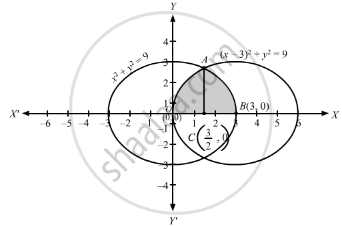
Let the two curves be named as y1 and y2 where
\[y_1 : \left( x - 3 \right)^2 + y^2 = 9 . . . . . \left( 1 \right)\]
\[ y_2 : x^2 + y^2 = 9 . . . . . \left( 2 \right)\]
The curve x2 + y2 = 9 represents a circle with centre (0, 0) and the radius is 3.
The curve (x − 3)2 + y2 = 9 represents a circle with centre (3, 0)  and has a radius 3.
To find the intersection points of two curves equate them.
On solving (1) and (2) we get

\[x = \frac{3}{2}\text{ and }y = \pm \frac{3\sqrt{3}}{2}\]
Therefore, intersection points are
\[\left( \frac{3}{2}, \frac{3\sqrt{3}}{2} \right)\text{ and }\left( \frac{3}{2}, - \frac{3\sqrt{3}}{2} \right)\]
Now, the required area (OABO) =2 [area(OACO) +area (CABC)]
Here,
\[\text{ Area }\left( OACO \right) = \int_0^\frac{3}{2} Y_1 d x\]
\[= \int_0^\frac{3}{2} \sqrt{9 - \left( x - 3 \right)^2} d x\] 
And
\[\text{ Area }\left( CABC \right) = \int_\frac{3}{2}^3 \left| Y_2 \right| d x\]
\[= \int_\frac{3}{2}^3 \sqrt{9 - x^2}dx\]
Thus the required area is given by,
A = 2 [area(OACO) +area(CABC)]
\[2\left( \int_0^\frac{3}{2} \sqrt{9 - \left( x - 3 \right)^2} d x + \int_\frac{3}{2}^3 \sqrt{9 - x^2} d x \right)\]
\[= 2 \left[ \frac{\left( x - 3 \right)}{2}\sqrt{9 - \left( x - 3 \right)^2} + \frac{9}{2} \sin^{- 1} \left( \frac{x - 3}{3} \right) \right]_0^\frac{3}{2} + 2 \left[ \frac{x}{2}\sqrt{9 - x^2} + \frac{9}{2} \sin^{- 1} \left( \frac{x}{3} \right) \right]^3_\frac{3}{2}\]
\[= 2\left[ \frac{\frac{3}{2} - 3}{2}\sqrt{9 - \left( \frac{3}{3} - 3 \right)^2} + \frac{9}{2} \sin^{- 1} \left( \frac{\frac{3}{2} - 3}{3} \right) - \frac{0 - 3}{2}\sqrt{9 - \left( 0 - 3 \right)^2} - \frac{9}{2} \sin^{- 1} \left( \frac{0 - 3}{3} \right) \right] + 2\left[ \frac{3}{2}\sqrt{9 - 3^2} + \frac{9}{2} \sin^{- 1} \left( \frac{3}{3} \right) - \left( \frac{3}{4}\sqrt{9 - \frac{9}{4}} \right) - \frac{9}{2} \sin^{- 1} \left( \frac{\frac{3}{2}}{3} \right) \right]\]
\[= 2\left[ - \frac{9\sqrt{3}}{8} - \frac{9\pi}{12} + \frac{9\pi}{4} \right] + 2\left[ \frac{9\pi}{4} - \frac{9\sqrt{3}}{8} - \frac{9\pi}{12} \right]\]
\[= - \frac{18\sqrt{3}}{8} - \frac{18\pi}{12} + \frac{18\pi}{4} + \frac{18\pi}{4} - \frac{18\sqrt{3}}{8} - \frac{18\pi}{12}\]
\[= \frac{- 36\sqrt{3}}{8} - \frac{36\pi}{12} + \frac{36\pi}{4}\]
\[= - \frac{9\sqrt{3}}{2} - 3\pi + 9\pi\]
\[= 6\pi - \frac{9\sqrt{3}}{2}\]
Hence the required area is \[6\pi - \frac{9\sqrt{3}}{2}\] square units.
shaalaa.com
  Is there an error in this question or solution?
Chapter 21: Areas of Bounded Regions - Exercise 21.3 [Page 52]

APPEARS IN

RD Sharma Mathematics [English] Class 12
Chapter 21 Areas of Bounded Regions
Exercise 21.3 | Q 42 | Page 52

Video TutorialsVIEW ALL [1]

RELATED QUESTIONS

Find the area of the region bounded by the curve y = sinx, the lines x=-π/2 , x=π/2 and X-axis


Find the area of the sector of a circle bounded by the circle x2 + y2 = 16 and the line y = x in the ftrst quadrant.


Find the area of the region bounded by the curve x2 = 16y, lines y = 2, y = 6 and Y-axis lying in the first quadrant.


Find the area lying above the x-axis and under the parabola y = 4x − x2.


Find the area under the curve y = \[\sqrt{6x + 4}\] above x-axis from x = 0 to x = 2. Draw a sketch of curve also.


Find the area bounded by the ellipse \[\frac{x^2}{a^2} + \frac{y^2}{b^2} = 1\]  and the ordinates x = ae and x = 0, where b2 = a2 (1 − e2) and e < 1.


Find the area of the region in the first quadrant bounded by the parabola y = 4x2 and the lines x = 0, y = 1 and y = 4.


Calculate the area of the region bounded by the parabolas y2 = x and x2 = y.


Find the area of the region bounded by y =\[\sqrt{x}\] and y = x.


Find the area of the region common to the circle x2 + y2 = 16 and the parabola y2 = 6x.


Prove that the area in the first quadrant enclosed by the x-axis, the line x = \[\sqrt{3}y\] and the circle x2 + y2 = 4 is π/3.


Prove that the area common to the two parabolas y = 2x2 and y = x2 + 4 is \[\frac{32}{3}\] sq. units.


Using integration, find the area of the region bounded by the triangle whose vertices are (−1, 2), (1, 5) and (3, 4). 


Find the area of the region bounded by the parabola y2 = 2x + 1 and the line x − y − 1 = 0.


Find the area of the region bounded by the curves y = x − 1 and (y − 1)2 = 4 (x + 1).


Using the method of integration, find the area of the region bounded by the following lines:
3x − y − 3 = 0, 2x + y − 12 = 0, x − 2y − 1 = 0.


Using integration, find the area of the triangle ABC coordinates of whose vertices are A (4, 1), B (6, 6) and C (8, 4).


Using integration find the area of the region bounded by the curves \[y = \sqrt{4 - x^2}, x^2 + y^2 - 4x = 0\] and the x-axis.


The area bounded by the parabola y2 = 4ax, latusrectum and x-axis is ___________ .


The ratio of the areas between the curves y = cos x and y = cos 2x and x-axis from x = 0 to x = π/3 is ________ .


Area of the region bounded by the curve y2 = 4x, y-axis and the line y = 3, is


Draw a rough sketch of the curve y2 = 4x and find the area of region enclosed by the curve and the line y = x.


Sketch the graphs of the curves y2 = x and y2 = 4 – 3x and find the area enclosed between them. 


Find the area of the region bounded by the parabolas y2 = 6x and x2 = 6y.


Find the area of the region included between y2 = 9x and y = x


Find the area bounded by the curve y = sinx between x = 0 and x = 2π.


The area of the region bounded by parabola y2 = x and the straight line 2y = x is ______.


The area of the region bounded by the curve y = sinx between the ordinates x = 0, x = `pi/2` and the x-axis is ______.


Using integration, find the area of the region in the first quadrant enclosed by the line x + y = 2, the parabola y2 = x and the x-axis.


Find the area of the region bounded by the ellipse `x^2/4 + y^2/9` = 1.


Find the area of the region enclosed by the curves y2 = x, x = `1/4`, y = 0 and x = 1, using integration.


The area enclosed by y2 = 8x and y = `sqrt(2x)` that lies outside the triangle formed by y = `sqrt(2x)`, x = 1, y = `2sqrt(2)`, is equal to ______.


Let the curve y = y(x) be the solution of the differential equation, `("dy")/("d"x) = 2(x + 1)`. If the numerical value of area bounded by the curve y = y(x) and x-axis is `(4sqrt(8))/3`, then the value of y(1) is equal to ______.


Sketch the region bounded by the lines 2x + y = 8, y = 2, y = 4 and the Y-axis. Hence, obtain its area using integration.


Using integration, find the area of the region bounded by y = mx (m > 0), x = 1, x = 2 and the X-axis.


Make a rough sketch of the region {(x, y) : 0 ≤ y ≤ x2 + 1, 0 ≤ y ≤ x + 1, 0 ≤ x ≤ 2} and find the area of the region, using the method of integration.


Using integration, find the area of the region bounded by the curve y2 = 4x and x2 = 4y.


Share
Notifications

Englishहिंदीमराठी


      Forgot password?
Use app×