Advertisements
Advertisements
Question
Find the area of the quadrilateral ABCD whose vertices are respectively A(1, 1), B(7, –3), C(12, 2) and D(7, 21).
Advertisements
Solution
Area of quadrilateral ABCD = | Area of ∆ABC | + | Area of ∆ACD |
We have,
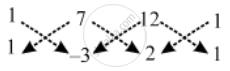
`∴ "Area of ∆ABC" = \frac { 1 }{ 2 } |(1× –3 + 7 × 2 + 12 × 1) – (7 × 1 + 12 × (–3) + 1× 2)|`
`"Area of ∆ABC" = \frac { 1 }{ 2 } |(–3 + 14 + 12) – (7 – 36 + 2)|`
`"Area of ∆ABC" = \frac { 1 }{ 2 } |23 + 27| = 25 sq. units`
Also, we have
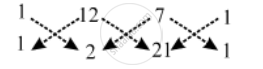
`"Area of ∆ACD" = \frac { 1 }{ 2 } |(1 ×2 + 12 × 21 + 7 × 1) – (12 × 1 + 7 × 2 + 1 × 21)|`
`"Area of ∆ACD" = \frac { 1 }{ 2 } |(2 + 252 + 7) – (12 + 14 + 21)|`
`"Area of ∆ACD" = \frac { 1 }{ 2 } |261 – 47| = 107 sq. units`
Area of quadrilateral ABCD = 25 + 107 = 132 sq. units
Type III: On collinearity of three points
Three points A(x1 , y1 ), B(x2 , y2 ) and C(x3 , y3 ) are collinear iff
Area of ∆ABC = 0 i.e., `x_1 (y_2 – y_3 ) + x_2 (y_3 – y_1 ) + x_3 (y_1 – y_2 ) = 0`
