Advertisements
Advertisements
Question
Find AB and BC, if:
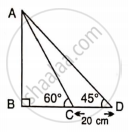
Sum
Advertisements
Solution
Let BC = x m
BD = BC + CD = (x + 20) cm
In ΔABD,
tan 45° = `"AB"/"BD"`
1 = `"AB"/(x + 20)`
x + 20 = AB ...(1)
In ΔABC
tan 60° = `"AB"/"BC"`
`sqrt(3) = "AB"/x`
x = `"AB"/sqrt(3)` ...(2)
From (1)
`"AB"/sqrt(3) + 20 = "AB"`
AB + `20sqrt(3) = sqrt(3)"AB"`
AB`(sqrt(3) -1) = 20sqrt(3)`
AB = `(20sqrt(3))/((sqrt(3) - 1)`
AB = `(20sqrt(3))/((sqrt(3) - 1)) xx ((sqrt(3)+1))/((sqrt(3)+1)`
AB = `(20sqrt(3)(sqrt(3) + 1))/(3 - 1)`
AB = 47.32 cm
From (2)
x = `"AB"/sqrt(3)`
x = `(47.32)/sqrt(3)`
x = 27.32 cm
∴ BC = x = 27.32 cm
Therefore, AB = 47.32 cm, BC = 27.32 cm.
shaalaa.com
Solution of Right Triangles
Is there an error in this question or solution?
Chapter 22: Solution of Right Triangles [Simple 2-D Problems Involving One Right-angled Triangle] - TEST YOURSELF [Page 344]
