Advertisements
Advertisements
Question
Figure shows a narrow beam of electrons entering with a velocity of 3 × 10⁷ m/s, symmetrically through the space between two parallel horizontal plates P1 `P_1^'` and P2 `P_2^'` kept 2 cm apart.
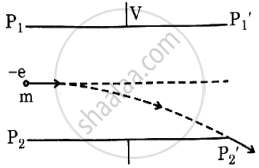
If each plate is 3 cm long, calculate the potential difference V applied between the plates so that the beam just strikes the end `P_2^'`.
Advertisements
Solution
Given: Initial velocity (u) = 3 × 10⁷ m/s
Plate separation (d) = 2 cm = 0.02 m
Plate length (l) = 3 cm = 0.03 m
m = 9.1 × 10⁻³¹ kg
e = 1.6 × 10⁻¹⁹ C
Electron enters midway, so vertical displacement:
y = `d/2`
= `0.02/2`
= 0.01 m
Time of travel between plates (t) = `l/u`
= `0.03/(3 xx 10^7)`
= 10−9 s
Vertical motion (y) = `1/2 at^2`
⇒ 0.01 = `1/2 a(10^-9)^2`
a = `0.02/(10^-18)`
= 2 × 10¹⁶ m/s2
Electric force (F) = ma = eE
E = `(m a)/e`
= `((9.1 xx 10^-31) xx (2 xx 10^16))/(1.6 xx 10^-19)`
E ≈ 1.14 × 10⁵ V/m
Potential difference (V) = Ed
= 1.14 × 105 × 0.02
≈ 2.3 × 10³ V
≈ 2.3 kV
