Advertisements
Advertisements
Question
Figure represents a square carrying charges +q, +q, -q, -q at its four corners as shown. Then the potential will be zero at points
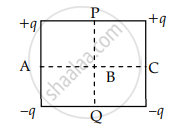
Options
A, B, C, P and Q
A, B and C
A, P, C and Q
P, B and Q
MCQ
Advertisements
Solution
A, B and C
Explanation:
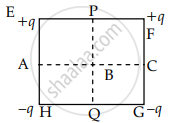
Potential at A = VE + VH
= `"kq"/"r"-"kq"/"r"` = 0
Potential at B = VE + VF + VG + VH
`"kq"/"r"_1+"kq"/"r"_1 - "kq"/"r"_1-"kq"/"r"_1` = 0
Potential at C = VF + VG
`"kq"/"r"-"kq"/"r"` = 0
Potential at P = VE + VF
`"kq"/"r"+"kq"/"r" = (2"kq")/"r"`
Potential at Q = VH + VG
`"kq"/"r"-"kq"/"r" = -(2"kq")/"r"`
So potential will be zero at point A, B and C.
Therefore, the correct answer is A, B and C.
shaalaa.com
Is there an error in this question or solution?
