Advertisements
Advertisements
Question
Explain the following.
The atomic radii of Cl, I, and Br are 99, 133, and 114 pm, respectively.
Advertisements
Solution
- Cl, I and Br belong to group 17 (halogen group) in the periodic table.
- As we move down the group from top to bottom in the periodic table, a new shell gets added to the atom of the elements.
- As a result, the effective nuclear charge decreases due to an increase in the atomic size as well as an increased shielding effect.
- Therefore, the valence electrons experience less attractive force from the nucleus and are held less tightly resulting in the increased atomic radius.
- Thus, their atomic radii increase in the following order down the group.
Cl (99 pm) < Br (114 pm) < I (133 pm)
Hence, the atomic radii of Cl, I, and Br are 99, 133, and 114 pm, respectively.
APPEARS IN
RELATED QUESTIONS
Explain the following.
The ionic radii of FΘ and Na⊕ are 133 and 98 pm, respectively.
Explain the following.
13Al is a metal, 14Si is a metalloid and 15P is a nonmetal.
Explain the following.
Cu forms coloured salts while Zn forms colourless salts.
Answer the following.
Ionization enthalpy of Li is 520 kJ mol-1 while that of F is 1681 kJ mol-1. Explain.
Answer the following.
Why the second ionization enthalpy is greater than the first ionization enthalpy?
Answer the following.
Why do the elements belonging to the same group have similar chemical properties?
Answer the following.
Explain electronegativity and electron gain enthalpy. Which of the two can be measured experimentally?
Choose the correct option.
The lanthanides are placed in the periodic table at
Choose the correct option.
If the valence shell electronic configuration is ns2np5, the element will belong to
Answer the following question.
Select the smaller ion form the following pair:
N3–, F–
With the help of a diagram answer the questions are given below:
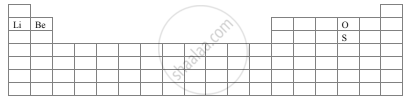
- Which atom should have smaller ionization energy, oxygen, or sulphur?
- The lithium forms +1 ions while beryllium forms +2 ions?
Define ionic radius
Define electronegativity
What are the valence electrons?
How does ionization enthalpy vary down the group and across a period?
How the atomic size vary in a group and across a period? Explain with suitable example.
Give reason.
Alkali metals have low ionization enthalpies.
Give reason.
Fluorine has less electron affinity than chlorine.
Give reason.
Noble gases possess relatively large atomic size.
