Advertisements
Advertisements
Question
Explain criss-cross inheritance with reference to bleeder’s disease by suitable charts.
Advertisements
Solution
Haemophilia (Bleeder’s disease) is an X-linked recessive disorder in which blood fails to clot or coagulate very slowly. The genes for normal clotting are dominant over the recessive genes for haemophilia. The person having a recessive gene for haemophilia is deficient in clotting factors (VIII or IX) in blood. Even minor injuries cause continuous bleeding, hence haemophilia is also called bleeder’s disease.
The recessive gene for haemophilia is located on a non-homologous region of the X chromosome. As there is no corresponding allele on Y chromosome to suppress its expression, so men suffer from this disease. Women suffer only when both X chromosomes have recessive genes (alleles).
The genotype of male and female individuals can be represented as follows:
| Sex | Normal | Haemophilic | Carrier |
| Male | XHY | XhY | - |
| Female | XHXH | XhXh | XHXh |
Like colour blindness, haemophilia also shows a criss-cross inheritance pattern. The inheritance of haemophilia can be studied with the help of the following examples:
1. Marriage between a haemophilic male and a normal female.
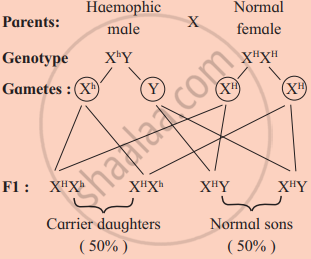
Sex linked inheritance (Bleeder’s disease)
2. Marriage between a carrier female (daughter) and a normal male.
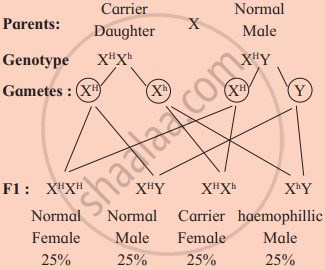
Sex linked inheritance (Bleeder’s disease)
