Advertisements
Advertisements
Question
Explain a suitable experiment of magnetic induction?
Advertisements
Solution
Experiment: Take a freely suspended magnetic needle and bring near its south pole, the south end of a bar magnet. The needle gets longer affects the south and of the magnetic needle as shown in the figure.
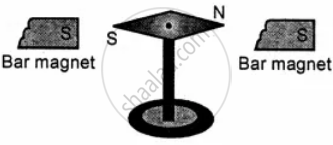
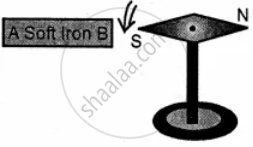
Place a flat piece of iron AB, in between the bar magnet and magnetic needle. It is observed that the south end of the needle is repelled. Remove the iron piece AB. It is observed that needle. comes back to its original position. Repeat the experiment, but remove the bar magnet instead of iron piece. We will observe that the needle does not get repelled and remains continuously in its original position.
From this experiment, it is clear that a soft iron piece behaves as a magnet only when a bar magnet is placed near it, when a bar magnet is removed then soft iron piece loses its magnetism.
APPEARS IN
RELATED QUESTIONS
Fill in the blank to complete the sentence :
The two ends of a magnet are called __________.
Fill in the blank to complete the sentence :
Unlike poles of a magnet ___________ each other.
Fill in the blank to complete the sentence :
Like poles of a magnet ______________ each other.
Fill in the blank to complete the sentence :
A freely suspended magnet rests in the geographic ___________ direction.
How do you account for the following fact?
Bar magnets lose their magnetism when heated strongly.
How do you account for the following fact?
Steel makes better permanent magnet than soft iron.
A magnet is carefully broken into two equal pieces as shown in the figure. How would the magnetic field strength of each piece compare with that of the original magnet? 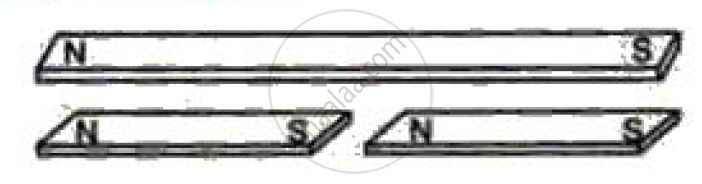
How would you test whether a piece of steel was magnetised
(i) If you had a magnet?
(ii) If there was no magnet available.
Give scientific reason:
A charge can be obtained on a rubbed ebonite rod held in the hand but not on a rubbed metal rod held in the hand.
