Advertisements
Advertisements
Question
Evaluate the significant distinction between the national and regional parties and assess the requirements for a regional party to become a national party.
Advertisements
Solution
The difference between the National parties and the regional Parties are:
- National parties are powerful in the nation and deal with national issues.
- Regional parties power is limited to a specific region or state, only the issues and demands of a specific region are discussed by regional parties.
- National parties actions offer preference to national issues over regional problems.
- Regional parties operations are confined to the state.
The regional parties must attain the following requirements to become a National Party:
- A party must gain at least six percent of the total votes in lok sabha or assembly elections in four states to be a national party and win at least four seats in lok sabha.
- A party has to receive at least six percent of the total votes in the legislative election to become a regional party and win at least two seats. Examples of national parties are the BJP, Congress and BSP. The examples of regional parties are DMK, Telugu Desam.)
APPEARS IN
RELATED QUESTIONS
Complete the following timeline showing the political parties and their year of establishment :

In a map of India, point out the places where national political parties have their influence.
Complete the following chart:
| Major national parties in India | 1. ______ |
| 2. ______ | |
| 3. ______ | |
| 4. ______ |
In China, the only one party that is allowed to rule is the ______.
What is the guiding philosophy of the Bharatiya Janata Party?
Which one of the following political parties exposed secularism and welfare of weaker sections and minorities?
Explain the following concept.
Regionalism
______ was recognized as a National Party by the Election Commission in 2016.
Explain whether the following statement is true or false. Give reasons for your answer:
When parties collaborate to achieve the majority, it leads to instability.
Two places A and B have been marked on the given outline map of India.
a) Identify them and write their correct names on the lines drawn near them.
- Indian National congress session at this place in 1920.
- The place where Mahatma Gandhi broke the salt law.
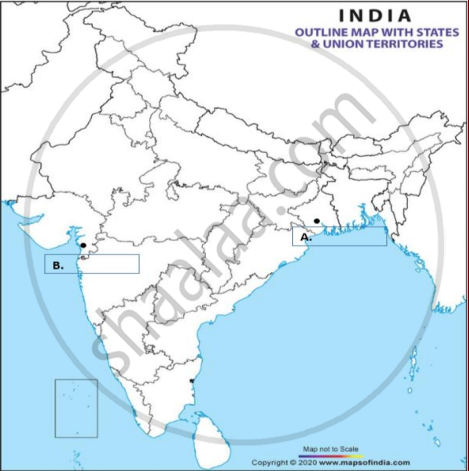
b) On the same outline map of India locate and label any 3 of the following with suitable symbols.
- A Coal mine in Tamil Nadu.
- A dam built on river Chenab in India.
- A largest natural major seaport located at Andhra Pradesh.
- Noida software technology park.
