Advertisements
Advertisements
Question
Each student in a class of 35 plays atleast one game among chess, carrom and table tennis. 22 play chess, 21 play carrom, 15 play table tennis, 10 play chess and table tennis, 8 play carrom and table tennis and 6 play all the three games. Find the number of students who play only carrom (Hint: Use Venn diagram)
Advertisements
Solution
Let A, B and C represent students play chess, carrom and table tennis.
n(A) = 22, n(B) = 21, n(C) = 15
n(A ∩ C) = 10, n(B ∩ C) = 8, n(A ∩ B ∩ C) = 6
Let “x” represent student play chess and carrom but not table tennis.
Let us represent the data in Venn diagram.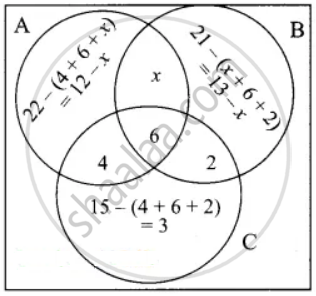
From the Venn diagram we get,
Number of students play atleast one game = 35
12 – x + x + 13 – x + 2 + 6 + 4 + 3 = 35
40 – 35 = x
5 = x
Number of students who play only carrom
= 13 – x
= 13 – 5
= 8
APPEARS IN
RELATED QUESTIONS
State, whether the pair of sets, given below, are equal sets or equivalent sets:
{5, 5, 2, 4} and {5, 4, 2, 2}
State true or false for the following. Correct the wrong statement.
If B = {1, 5, 51, 15, 5, 1}, then n(B) = 6.
If n(A) = 25, n(B) = 40, n(A ∪ B) = 50 and n(B’) = 25, find n(A ∩ B) and n(U).
If U = {x : x ∈ N, x ≤ 10}, A = {2, 3, 4, 8, 10} and B = {1, 2, 5, 8, 10}, then verify that n(A ∪ B) = n(A) + n(B) – n(A ∩ B)
In a class, all students take part in either music or drama or both. 25 students take part in music, 30 students take part in drama and 8 students take part in both music and drama. Find the total number of students in the class
In a colony, 275 families buy Tamil newspaper, 150 families buy English newspaper, 45 families buy Hindi newspaper, 125 families buy Tamil and English newspaper, 17 families buy English and Hindi newspapers, 5 families buy Tamil and Hindi newspaper and 3 families buy all the three newspaper. If each family buy atleast one of these newspaper then find Number of families buy atleast two newspaper
In a colony, 275 families buy Tamil newspaper, 150 families buy English newspaper, 45 families buy Hindi newspaper, 125 families buy Tamil and English newspaper, 17 families buy English and Hindi newspapers, 5 families buy Tamil and Hindi newspaper and 3 families buy all the three newspaper. If each family buy atleast one of these newspaper then find Total number of families in the colony
A survey of 1000 farmers found that 600 grew paddy, 350 grew ragi, 280 grew corn, 120 grew paddy and ragi, 100 grew ragi and corn, 80 grew paddy and corn. If each farmer grew atleast anyone of the above three, then find the number of farmers who grew all the three.
The shaded region in the Venn diagram is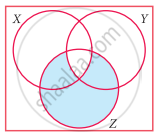
In a city, 40% people like only one fruit, 35% people like only two fruits, 20% people like all the three fruits. How many percentage of people do not like any one of the above three fruits?
