Advertisements
Advertisements
Question
During summers in India, one of the common practice to keep cool is to make ice balls of crushed ice, dip it in flavoured sugar syrup and sip it. For this a stick is inserted into crushed ice and is squeezed in the palm to make it into the ball. Equivalently in winter, in those areas where it snows, people make snow balls and throw around. Explain the formation of ball out of crushed ice or snow in the light of P–T diagram of water.
Advertisements
Solution
Refer to the P–T diagram of water and the double-headed arrow. Increasing pressure at 0°C and 1 atm take ice into a liquid state and decreasing pressure in a liquid state at O°C and 1 atm takes water to the ice state.
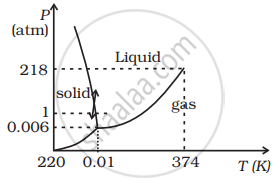
When crushed ice is squeezed, some of it melts, filling up gap between ice flakes upon releasing pressure. This water freezes, binding all ice flakes and making the ball more stable.
APPEARS IN
RELATED QUESTIONS
Answer the following questions based on the P–T phase diagram of CO2:
CO2 at 1 atm pressure and temperature – 60 °C is compressed isothermally. Does it go through a liquid phase?
Answer the following questions based on the P–T phase diagram of CO2:
Describe qualitatively the changes in a given mass of solid CO2 at 10 atm pressure and temperature –65 °C as it is heated up to room temperature at constant pressure.
Answer the following questions based on the P–T phase diagram of CO2:
Describe qualitatively the changes in a given mass of solid CO2 at 10 atm pressure and temperature –65 °C as it is heated up to room temperature at constant pressure.
A ‘thermacole’ icebox is a cheap and efficient method for storing small quantities of cooked food in summer in particular. A cubical icebox of side 30 cm has a thickness of 5.0 cm. If 4.0 kg of ice is put in the box, estimate the amount of ice remaining after 6 h. The outside temperature is 45 °C, and coefficient of thermal conductivity of thermacole is 0.01 J s–1 m–1 K–1. [Heat of fusion of water = 335 × 103 J kg–1]
A brass boiler has a base area of 0.15 m2 and thickness 1.0 cm. It boils water at the rate of 6.0 kg/min when placed on a gas stove. Estimate the temperature of the part of the flame in contact with the boiler. The thermal conductivity of brass = 109 J s –1 m–1 K–1; Heat of vaporisation of water = 2256 × 103 J kg–1.
A metal block of heat capacity 80 J°C−1 placed in a room at 20°C is heated electrically. The heater is switched off when the temperature reaches 30°C. The temperature of the block rises at the rate of 2°C s−1 just after the heater is switched on and falls at the rate of 0.2°C s−1 just after the heater is switched off. Assume Newton's law of cooling to hold.
- Find the power of the heater.
- Find the power radiated by the block just after the heater is switched off.
- Find the power radiated by the block when the temperature of the block is 25°C.
- Assuming that the power radiated at 25°C represents the average value in the heating process, find the time for which the heater was kept on.
The radii of two copper spheres are in the ratio 1 : 3 and their temperatures are in the ratio 9 : 1. The ratio of heat content in them will be:
Mark the correct options:
- A system X is in thermal equilibrium with Y but not with Z. System Y and Z may be in thermal equilibrium with each other.
- A system X is in thermal equilibrium with Y but not with Z. Systems Y and Z are not in thermal equilibrium with each other.
- A system X is neither in thermal equilibrium with Y nor with Z. The systems Y and Z must be in thermal equilibrium with each other.
- A system X is neither in thermal equilibrium with Y nor with Z. The system Y and Z may be in thermal equilibrium with each other.
100 g of water is supercooled to –10°C. At this point, due to some disturbance mechanised or otherwise some of it suddenly freezes to ice. What will be the temperature of the resultant mixture and how much mass would freeze?
`[S_w = 1cal/g/^circC and L_(Fusion)^w = 80cal/g]`
What happens to temperature at 0°C during melting of ice?
Why does water stay at 100°C while boiling?
Effect of increasing external pressure on boiling point ______.
In a heating curve of ice and water, which part represents the latent heat of fusion?
Why is the latent heat of vaporisation much greater than the latent heat of fusion?
For 1 kg of water, which phase change requires more energy?
