Advertisements
Advertisements
Question
During a total solar eclipse the moon almost entirely covers the sphere of the sun. Write the relation between the distances and sizes of the sun and moon.
Advertisements
Solution
In geometry, a solid angle (symbol: Ω or w) is the twodimensional angle in three-dimensional space that an object subtends at a point. It is a measure of how large the object appears to an observer looking from that point. In the International System of Units (SI), a solid angle is expressed in a dimensionless unit called a steradian (symbol: sr)
Solid Angle
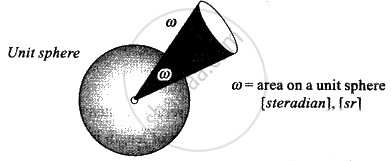
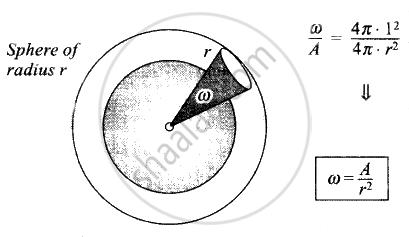
A small object nearby may subtend the same solid angle as a larger object farther away. For example, although the Moon is much smaller than the Sun, it is also much closer to Earth.
The diagram given below shows that the moon almost entirely covers the sphere of the sun.
Rme = Distance of moon from earth
Rse = Distance of sun from the earth
Let the solid angle made by the sun and moon is dΩ, we can write
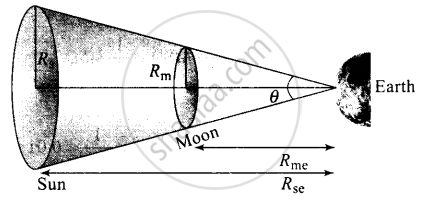
dΩ = `A_(sun)/R_(se)^2 = A_("moon")/R_(me)^2`
Here, Asun = Area of the sun
Amoon = Area of the moon
⇒ θ = `(πR_s^2)/(R_(se)^2) = (πR_m^2)/(R_(me)^2)`
⇒ `(R_s/R_(se))^2 = (R_m/R_(me))^2`
⇒ `R_s/R_(se) = R_m/R_(me)` or `R_s/R_m = R_(se)/R_(me)`
(Here, radius of the sun and moon represent their sizes respectively)
