Advertisements
Advertisements
Question
Distinguish between D.C. and A.C.
Distinguish Between
Advertisements
Solution
| D. C. | A. C. | |
| Definition | In DC, the current's direction doesn't change. | In AC, the direction of the current keeps reversing periodically. |
| Load Type | DC’s load is generally resistive in nature. | AC’s load is resistive, inductive or capacitive. |
| The direction of flowing electrons | In DC, the flowing electrons are unidirectional | The direction of flow of electrons in AC is bidirectional. |
| Frequency | DC's frequency is Zero. | AC's frequency is 50 or 60 Hz. |
| Transmission | We can transmit it over a long distance with negligible losses. | We can transmit it over a long distance with few losses. |
| Purpose | Used in electroplating, electrolysis, electronic equipment, and more. | Used in factories, industries, households. |
| Passive Parameter | Resistance | Impedance |
shaalaa.com
Direction of the Electric Current - Conventional and Electronic Flow
Is there an error in this question or solution?
APPEARS IN
RELATED QUESTIONS
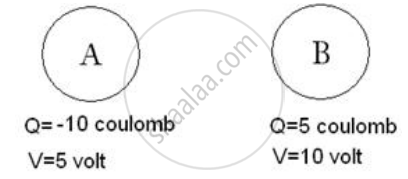
Figure. below shows two conductors A and B. Their charges and potentials are given in diagram. State the direction of (i) flow of electrons and (ii) flow of current, when both the conductors are joined by a metal wire.
What is direct current?
Which has a greater resistance: an ammeter or a voltmeter?
Find the number of electrons that would flow per second through the cross-section of a wire when 1 A current flows in it.
Define the electrical resistance of a metal. Write its SI unit.
How is a voltameter different from a voltmeter?
Differentiate between:
Flow of electron and flow of conventional current.
The direction of conventional current is ______ to electron flow.
milli ampere: micro ampere : : 10-3A : ______.
The direction opposite to the movement of electron is called ______ current.
