Advertisements
Advertisements
Question
Describe the theory of personality put forward by Abraham Maslow.
Very Long Answer
Advertisements
Solution
- According to Maslow, the fundamental quality of personality is that individuals are essentially decent and deserving of respect.
- He believed that if the proper circumstances were there, people would progress toward realising their potential.
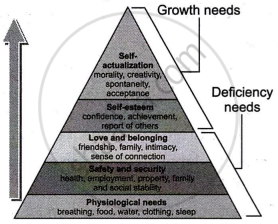
- Maslow asserts that human needs are arranged in a hierarchy, with self-actualising wants at the top and physiological requirements at the bottom.
Maslow’s Hierarchy of needs:
- Basic physiological wants like hunger and thirst are at the bottom of the need hierarchy.
- It then advances to requirements for safety and security like clothing and housing.
- The need for affection and belonging, including acceptance from friends, family, and the community, is the third stage. Another name for this is social needs.
- These three needs are referred to as lower-order or deficient needs. According to Maslow, before humans can aspire for the next higher-order or more complex requirements, lower-order needs must be met.
- Esteem needs, which include the need for status, prestige, and self-respect, make up the fourth stage of needs.
- Self- realisation is the last step, when a person has realised their full potential and is satisfied with lower-order wants. Rarely is this reached.
- The needs for self-actualization and self-esteem are referred to as growth needs.
Characteristics of Self-actualised people:
Maslow characterises self-actualised people. They are as follows:
- More efficient perception of reality: They see reality as it is, not as they want it to be. They offer a more objective perspective.
- Acceptance: They show respect for themselves and others, accepting nature as it is without seeking perfection.
- Spontaneity, simplicity and naturalness: They display genuine behaviour. Therefore, their behaviour is spontaneous and simple.
- Problem-centred: Self-actualised individuals are task-oriented. They are ego-oriented and view a problem as a life mission.
- Detachment: They can be alone and not feel lonely. They enjoy seclusion and privacy.
- Autonomy: People that are self-sufficient rely on their own abilities for growth and development. They value 'free will' and consider themselves responsible, active, and self-disciplined.
- Continued appreciation of freshness: They demonstrate the ability to value even the most routine events in their lives.
- Peak or mystic experiences: Maslow noted that "oceanic feelings" or peak experiences are typical for self-actualised individuals. This includes both times of great excitement and times of calm and rest. The individual has a sudden realisation and feels at one with the universe.
- Social interest: Self-actualised individuals feel a strong sense of connection to humanity. Feeling sympathy and affection for all people.
- Interpersonal relations: They tend to have more intimate personal relationships. Their group of close pals is narrow.
Criticism
- The humanistic concept of 'free will' has some validity. However, the concept undermines the influence of other influences on behaviour.
- Many concepts and issues, such as self-awareness and peak experiences, remain incompletely explained. Hence, these notions remain confused.
shaalaa.com
Is there an error in this question or solution?
2019-2020 (March) Official
