Advertisements
Advertisements
Question
Describe the anomalous expansion of water. How is it helpful in our lives?
Advertisements
Solution
Anomalous expansion of water: Liquids expand on heating and contract on cooling at moderate temperatures. But water exhibits anomalous behavior. It contracts on heating between 0°C and 4°C. The volume of the given amount of water decreases as it is cooled from room temperature until it reaches 4°C. Below 4°C the volume increases and so the density decreases. This means that the water has a maximum density of 4°C. This behavior of water is called the anomalous expansion of water.
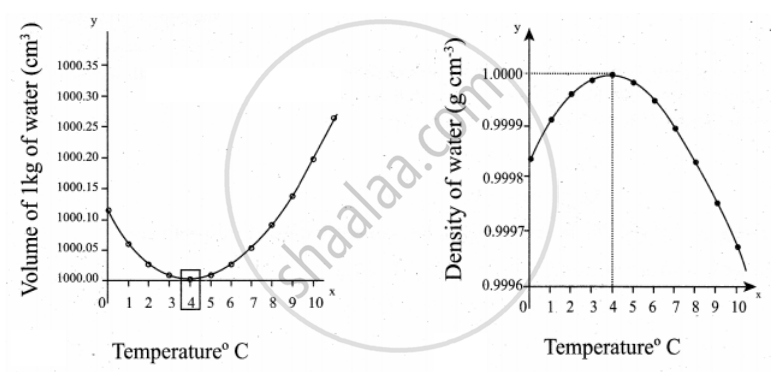
Anomalous Expansion of water

Anomalous expansion of water in lakes
In cold countries during the winter season, the surface of the lakes will be at a lower temperature than the bottom as shown in the Figure. Since the solid water (ice) has a lower density than its liquid form, below 4°C, the frozen water will be on the top surface above the liquid water (ice floats). This is due to the anomalous expansion of water. As the water in lakes and ponds freeze only at the top the species living in the lakes will be safe at the bottom.
APPEARS IN
RELATED QUESTIONS
Choose the correct option.
If two temperatures differ by 25° C on Celsius scale, the difference in temperature on Fahrenheit scale is
What is a thermal expansion?
Define thermal conductivity.
Calculate the number of moles of air is in the inflated balloon at room temperature as shown in the figure.

The radius of the balloon is 10 cm, and the pressure inside the balloon is 180 kPa.
The temperature of a uniform rod of length L having a coefficient of linear expansion αL is changed by ∆T. Calculate the new moment of inertia of the uniform rod about the axis passing through its center and perpendicular to an axis of the rod.
A man starts bicycling in the morning at a temperature around 25°C, he checked the pressure of tire which is equal to be 500 kPa. Afternoon he found that the absolute pressure in the tyre is increased to 520 kPa. By assuming the expansion of tyre is negligible, what is the temperature of tyre at afternoon?
What does the temperature of a body tell us?
Which of the following is the fourth fundamental quantity introduced while studying heat?
Which three fundamental quantities were used to describe mechanical systems before studying heat?
Why is the sense of touch not sufficient to measure temperature scientifically?
