Advertisements
Advertisements
Questions
Describe cost on the basis of behaviour.
Classify the cost based on behaviour.
Advertisements
Solution
- Fixed costs: Fixed costs are those costs which remain fixed in amount irrespective of changes in the volume of output during a given period of time. Such costs do not change with changes (increase or decrease) in the level of activity upto a certain limit. Rent, insurance, depreciation of plant are examples of fixed costs. The behaviour of fixed costs is shown in the following graph.

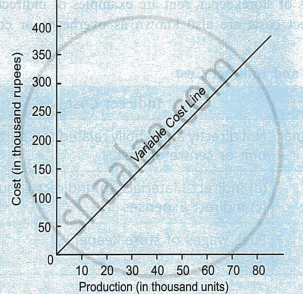
This graph shows that cost remains fixed at ₹ 1,50,000 from 0 to 1,00,000 units of output. It must be noted that fixed cost remains constant in total but fixed cost per unit of production changes with changes in the level of output. For example, when production is 30,000 units, fixed cost per unit is ₹ 5 (1,50,000 ÷ 30,000) but when production is 60,000 units, fixed cost per unit decreases to ₹ 2.5 (1,50,000 ÷ 60,000). - Variable costs: Variable costs are those costs which vary in amount with changes in the level of output or activity. Such costs increase and decrease in the same proportion in which the level of output increases or decreases. Variable costs vary in total amount but remain constant per unit of production. For example, when the level of output increases from 5,000 units to 6,000 units, the amount of variable costs increase from ₹ 25,000 to ₹ 30,000. In this case, the variable cost per unit remains unchanged at ₹ 5 (25,000 ÷ 5,000 and 30,000 ÷ 6,000). Thus, there is a linear relationship between volume of production and total variable costs. The behaviour of variable costs is shown in the graph. Sugarcane used to produce sugar is an example of variable cost.
- Semi-variable cost or semi-fixed cost: Semi-fixed costs are those costs which vary but not in direct proportion to changes in the volume of production. They are a combination of fixed and variable costs. In other words, semi-fixed costs are partly fixed and partly variable. Such costs are neither perfectly fixed nor absolutely variable. The fixed component of such costs represents the cost of providing capacity and the variable component is caused by using the capacity. For example, the rent of a telephone is a fixed cost whereas the charges for calls made during a month are a variable cost. The behaviour of semi-fixed costs is shown in the following graph.

APPEARS IN
RELATED QUESTIONS
A firm has to pay a fixed rent of ₹ 500 for the postpaid mobile bill and further pay extra charges for the calls made in a month. Identify the type of cost mentioned here.
Indirect material scrap is adjusted along with ______.
Overheads are often related to accounting concepts such as fixed cost and ______ cost.
Total variable cost per unit increases ______.
The cost remains same at all levels of output is called ______ cost.
Which of the following cost is time based?
Which of the following best describes a fixed cost?
Direct cost increases when ______.
What is opportunity cost?
Explain the following:
Sunk cost
Distinguish between controllable and uncontrollable costs.
Distinguish between shut down cost and sunk cost.
Give an example of opportunity cost.
The term “variable costs” refers to ______.
Amount spent to purchase a machinery is the example of ______ cost.
Variable cost per unit increases when ______.
What is meant by variable cost?
What do you mean by Semi-Fixed cost?
Classify cost according to its nature.
Explain with an example the meaning of fixed costs.
