Advertisements
Advertisements
Question
Derive an expression for electrostatic potential due to an electric dipole.
Advertisements
Solution
Consider two equal and opposite charges separated by a small distance 2a. The point P is located at a distance r from the midpoint of the dipole. Let θ be the angle between the line OP and dipole axis AB.
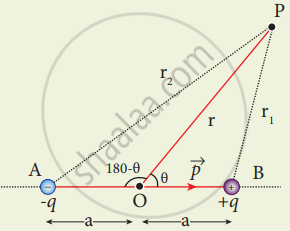
Potential due to electric dipole
Let r1 be the distance of point P from +q and r2 be the distance of point P from -q.
Potential at P due to charge +q = `1/(4 pi ε_0) "q"/"r"_1`
Potential at P due to charge –q = `−1/(4 pi ε_0) "q"/"r"_1`
Total potential at the point P
V = `1/(4 pi ε_0) "q"(1/"r"_1 - 1/"r"_2)`
By the cosine law for triangle BOP
r12 =r2 + a2 – 2ra cos θ
`"r"_1^2 = "r"^2 (1 + "a"^2/"r"^2 - "2a"/"r" cos theta)`
`"a"^2/"r"^2` is very small, and can be neglected.
`"r"_1^2 = "r"^2(1 - "2a" (cos theta)/"r")` (or)
`"r"_1 = "r"(1 - "2a"/"r" cos theta)^2`
`1/"r"_1 = 1/"r" (1 - "2a"/"r" cos theta)^(-1/2)`
Since `"a"/"r"` << 1, we can use binomial theorem and retain the terms up to first order
`1/"r"_1 = 1/"r" (1 + "a"/"r" cos theta)` ....(2)
Similarly applying the cosine law for triangle A0P,
r22 = r2 + a2 – 2racos(180-θ)
since cos(180-θ) = – cos θ
r22 = r2 + a2 +2ra cos θ
Neglecting `"a"^2/"r"^2 "r"^_2 = "r"^2 (1 + (2"a" cos theta)/"r")`
`"r"_2 = "r" (1 + (2"a" cos theta)/"r")^(1/2)`
Using Binomial theorem, we get
`1/"r"_2 = 1/"r" (1 - "a" (cos theta)/"r")` ....(3)
Sun (2) and (3) in eqn (1), we get
V = `"q"/(4piε_0) (1/"r"(1 + "a"(cos theta)/"r") - 1/"r" (1 - "a" (cos theta)/"r"))`
V = `"q"/(4piε_0) (1/"r"(1 + "a" (cos theta)/"r" - 1 + "a" (cos theta)/"r"))`
V = `1/(4piε_0) (2"aq")/"r"^2 cos theta`
But the electric dipole moment p = 2qa and we get,
V = `1/(4piε_0) (("p" cos theta)/"r"^2)`
p cos θ = `vec"p" * hat"r"`, where `hat "r"` is the unit vector from the point O to point P.
V = `1/(4piε_0) ((vec"p" * hat"r")/"r"^2)`
Special Cases:
| If the point lies near | θ | V |
| +q | O° | `"p"/(4 piε_0"r"^2)` |
| -q | 180° | -`"p"/(4 piε_0"r"^2)` |
| equatorial point | 90° | 0 |
