Advertisements
Advertisements
Question
Define watt-hour. How many joules are equal to 1 watt-hour?
Advertisements
Solution
Watt hour is a smaller commercial unit of electric energy, which is spent by an electric appliance of 1 watt power in 1 hour, i.e.
1 watt hour = 1 watt × hour = 1 watt × (60 × 60)s
= 3600 joule.
APPEARS IN
RELATED QUESTIONS
An electric bulb is rated 220 V and 100 W. When it is operated on 110 V, the power consumed will be ______.
What is consumed using different electrical appliances, for which electricity bills are paid?
If a bulb of 60W is connected across a source of 220V, find the current drawn by it.
State two factors on which the electrical energy consumed by an electrical appliance depends.
What is the SI unit of (i) electric energy, and (ii) electric power?
An electric motor takes 5 amperes current form a 220 volt supply line. Calculate the power of the motor and electric energy consumed by it in 2 hours.
What is meant by "electric power"?
An electric kettle for use on a 230 V supply is rated 3000 W. For safe working, the cable connected to it should be able to carry at least:
(a) 2 A
(b) 5 A
(c) 10 A
(d) 15 A
In a filament type light bulb, most of the electric power consumed appears as:
(a) visible light
(b) infra-red-rays
(c) ultraviolet rays
(d) fluorescent light
Electrical power P is given by the expression P = (Q × V) ÷ time. What do the symbols Q and V represent?
An electric bulb is rated ‘100 W, 250 V’. What information does this convey?
A battery of e.m.f 15 V and internal resistance 2 Ω is connected to two resistors of resistance 4 ohm and 6 ohm joined in series. Find the electrical energy spent per minute in 6 ohm resistor.
A simple electric circuit has a 30 V battery and a resistor ot 60 o. What will be the current in the circuit? The resistance of the oonnecting wires is negligible.
The diagram shows a coil connected to a center zero galvanometerG . The galvanometer shows a deflect ion to the right when the north pole N of a powerful magnet is moved to the right as shown .
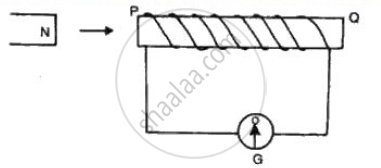
(i) Explain, why the defelct ion occurs in the galvanometer.
(ii ) State whether th e current in the coil is cl ockwise or anticl ockwise
when viewed from the end P.
(iii ) State th e observation in G when the coil is moved away from north
pole N of the magnet keeping the magnet stationary.
(iv)State the observation in G when both the coil and the magnet are
moved to right at th e same speed .
State three factors on which the heat produced in a metallic wire due to passage of current in it depends.
The electric bulbs used these days have a coil-coiled filament. State its reason.
What changes in energy occur in an electric bulb?
A device is used to transform 12 V a.c. to 200 V a.c. What is the name of this device? Name the principle on which it works.
What is the order of current drawn by appliances connected to the ‘power circuit’ of a household?
Give two precautious that you would take while putting off an electric switch.
Why is the electric power from the generating station transmitted at high voltage?
An electric heater is rated 220 V, 550 W. Electrical energy is also measured in kWh. What do you understand by a kilo-watt-hour?
Three 250 W heaters are connected in parallel to a 100 V supply, Calculate the resistance of each heater.
How can electric energy consumed by an electric appliance be calculated in kilowatt hour (kWh)?
A. bulb is rated at 100W, 250V and another one at 60W, 250V. What is the current flowing in the circuit if the two bulbs are put in series across a 220 V mains supply?
An electrical appliance is rated 1500 W, 250 V. This appliance is connected to 250 V mains. Calculate:
(i) the current drawn,
(ii) the electrical energy consumed in 60 hours,
(iii) the cost of electrical energy consumed at Rs. 2.50 per kWh.
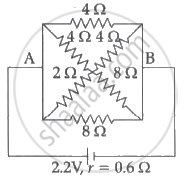
In the given figure, the emf of the cell is 2.2 V, and if internal resistance is 0.6 Ω. Calculate the power dissipated in the whole circuit.