Advertisements
Advertisements
Question
Consider the situation of the previous problem. Suppose the block of mass m1 is pulled by a constant force F1 and the other block is pulled by a constant force F2. Find the maximum elongation that the spring will suffer.
Advertisements
Solution
Given:
Force on block of mass, m1 = F1
Force on block of mass, m2 = F2
Let the acceleration produced in mass m1 be a1.
\[a_1 = \frac{F_1 - F_2}{m_1 + m_2}\]
Let the acceleration of mass m2 be a2.
\[a_2 = \frac{F_2 - F_1}{m_1 + m_2}\]
Due to the force F2, the mass m1 experiences a pseudo force.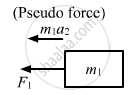
\[\therefore \text{ Net force on m}_1 = F_1 + m_1 a_2 \]
\[F' = F_1 + m_1 \times \frac{( F_2 - F_1 )}{m_1 + m_2}\]
\[ = \frac{m_1 F_1 + m_2 F_1 + m_1 F_2 - m_1 F_1}{m_1 + m_2}\]
\[ = \frac{m_2 F_1 + m_1 F_2}{m_1 + m_2}\]
Similarly, mass m2 experiences a pseudo force due to force F1.
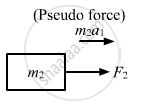
\[\therefore \text{ Net force on m}_2 = F_2 + m_2 a_1\]
\[F " = F_2 + m_2 \times \frac{( F_1 - F_2 )}{m_1 + m_2}\]
\[ = \frac{m_1 F_2 + m_2 F_2 + m_2 F_1 - m_2 F_2}{m_1 + m_2}\]
\[ = \frac{m_1 F_2 + m_2 F_1}{m_1 + m_2}\]
Let m1 be displaced by a distance x1 and m2 be displaced by a distance x2.
Therefore, the maximum elongation of the spring = x1 + x2
Work done by the blocks = Energy stored in the spring
\[\Rightarrow \frac{m_2 F_1 + m_1 F_2}{m_1 + m_2} \times x_1 \times \frac{m_2 F_1 + m_1 F_2}{m_1 + m_2} \times x_2 = \left( \frac{1}{2} \right)k( x_1 + x_2 )^2 \]
\[ \Rightarrow x_1 + x_2 = \frac{2}{k}\left( \frac{m_1 F_2 + m_2 F_1}{m_1 + m_2} \right)\]
