Advertisements
Advertisements
Question
Read the following paragraph and answer the questions that follow:
|
Capacitors are manufactured with certain standard capacitances and working voltages. However, these standard values may not be the ones that are actually needed in a particular application. Two or more capacitors can be grouped in series or in parallel to achieve desired capacitance and voltage. When connected in series, the total capacitance decreases while the voltage rating increases, whereas in parallel connections, the total capacitance increases and maintains the same voltage rating. A capacitor stores energy in the electric field between its plates and stored energy is proportional to the square of the voltage and capacitance `U = 1/2 C V^2`, where symbols have their usual meanings.
Two capacitors, one of 3 µF and the other of 6 µF, are connected in series in the circuit as shown in the figure, for a long time. |
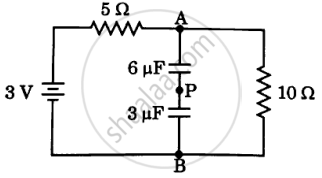
(i) The total capacitance of the circuit is ______.
- 6 µF
- 3 µF
- 9 µF
- 2 µF
(ii) The current in the 10 resistor is ______.
- 0.3 A
- 0.6 А
- 0.2 А
- 0
(iii) The potential difference between point A and B is ______.
- 2 V
- 0.3 V
- 0.2 V
- 3 V
(iv) (a) The value of charge on the plates of the 6 µF capacitor is ______.
- 6 μC
- 4μC
- 12 μC
- 6 μC
OR
(iv) (b) The wire between two capacitors is cut at point P. The current in the circuit will ______.
- increase
- decrease
- remain the same
- first increase then become stable
Advertisements
Solution
(i) The total capacitance of the circuit is 2 µF.
Explanation:
For capacitors in series:
`1/(C_(eq)) = 1/C_1 + 1/C_2`
`1/(C_(eq)) = 1/3 + 1/6`
`1/(C_(eq)) = (2 + 1)/6`
`1/(C_(eq)) = 3/6`
`1/(C_(eq)) = 1/2`
Ceq = 2µF
(ii) The current in the 10 resistor is 0.
Explanation:
After a long time in a DC circuit:
- Capacitors act as open circuits.
- No steady current passes through the capacitor branch.
Therefore, no current flows through the loop containing the 10 Ω resistor.
(iii) The potential difference between point A and B is 3 V.
Explanation:
Because capacitors block DC current, no current flows through the resistors, so there is no voltage drop across them.
As a result, the entire battery voltage appears across points A and B.
VAB = 3 V
(iv) (a) The value of charge on the plates of the 6 µF capacitor is 6 µC.
Explanation:
For capacitors in series: The charge on each capacitor is the same.
Q = CeqV
= 2 μF × 3 V
= 6 μC
Hence, the charge on the 6 µF capacitor is 6 µC.
(iv) (b) The wire between two capacitors is cut at point P. The current in the circuit will decrease.
Explanation:
Cutting the wire disconnects the branch that includes the capacitors.
This raises the effective resistance in the circuit loop, which lowers the current. Therefore, the current decreases.
