Advertisements
Advertisements
Question
Can you identify the MLAs of the ruling party and the opposition in the illustration? Colour the ruling party in one colour and the opposition in another.

Advertisements
Solution
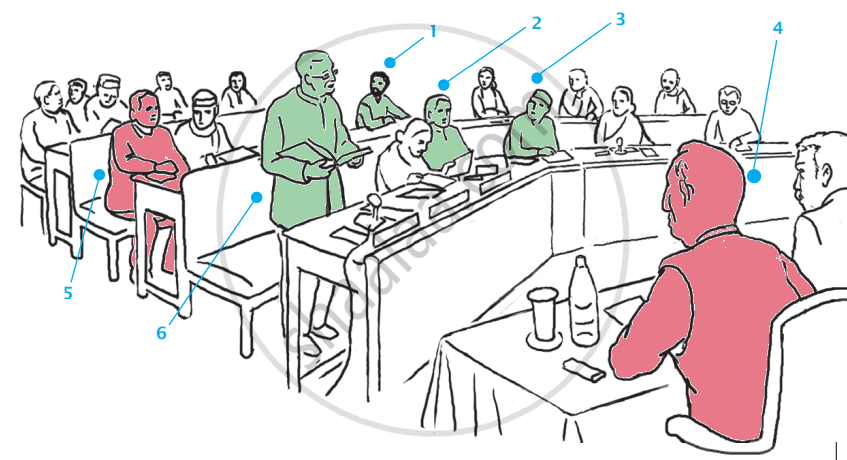
Ruling Party MLAs
Usually, the ruling party sits near the Speaker’s right-hand side and is more actively participating. In this image, MLAs 1 to 3 are seated attentively in front of the Speaker, and MLA 6 is possibly the Speaker himself or an active ruling party leader.
- MLA 1 – Appears engaged, listening to the Speaker
- MLA 2 – Focused, possibly taking notes
- MLA 3 – Observant and attentive
- MLA 6 – Likely part of ruling party front bench (or the Speaker)
Opposition MLAs
On the left side (from the viewer’s perspective), the figures are not actively engaging. They are more in the background, likely representing the opposition.
- MLA 4 – Seated on the opposite side of the table
- MLA 5 – Sitting in a row of less involved individuals, typical of opposition seating
APPEARS IN
RELATED QUESTIONS
Why should decisions are taken by the Chief Minister and other ministers be debated in the Legislative Assembly?
Very Short Type Question:
How will you define a Legislative Assembly?
Very Short Type Question:
Why do people in a democratic set up organise meetings?
Very Short Type Question:
The government works at three levels. Name them.
Short Type Question:
What do you mean by an MLA? Is it necessary to become a member of any political party to become an MLA?
What were the main arguments put forward by different MLAs who thought that the government was not taking the situation in a serious manner?
If you were the health minister, how would you respond to the above discussion?
Do you think the above debate would have been useful in some ways? How? Discuss.
In the working of the government, explain the difference between being an MLA and an MLA who is also a minister.
