Advertisements
Advertisements
Question
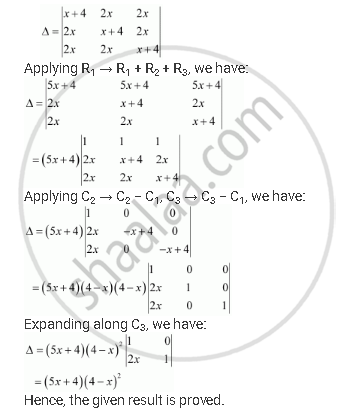
By using properties of determinants, show that:
`|(x+4,2x,2x),(2x,x+4,2x),(2x , 2x, x+4)| = (5x + 4)(4-x)^2`
Advertisements
Solution

APPEARS IN
RELATED QUESTIONS
Using properties of determinants, prove that `|[2y,y-z-x,2y],[2z,2z,z-x-y],[x-y-z,2x,2x]|=(x+y+z)^3`
Using properties of determinants, prove that
`|[b+c,c+a,a+b],[q+r,r+p,p+q],[y+z,z+x,x+y]|=2|[a,b,c],[p,q,r],[x,y,z]|`
Using the property of determinants and without expanding, prove that:
`|(b+c, q+r, y+z),(c+a, r+p, z +x),(a+b, p+q, x + y )| = 2|(a,p,x),(b,q,y),(c, r,z)|`
By using properties of determinants, show that:
`|(1+a^2-b^2, 2ab, -2b),(2ab, 1-a^+b^2, 2a),(2b, -2a, 1-a^2-b^2)| = (1+a^2+b^2)`
Using properties of determinants, prove that `|(x,x+y,x+2y),(x+2y, x,x+y),(x+y, x+2y, x)| = 9y^2(x + y)`
Using properties of determinants, prove the following:
Using properties of determinants, prove that:
`|(a,b,b+c),(c,a,c+a),(b,c,a+b)|` = (a+b+c)(a-c)2
Using properties of determinants, prove that:
`|[a^2 + 1, ab, ac], [ba, b^2 + 1, bc ], [ca, cb, c^2+1]| = a^2 + b^2 + c^2 + 1`
Evaluate the following determinants:
`|(x - 1, x, x - 2),(0, x - 2, x - 3),(0, 0, x - 3)| = 0`
Solve the following equation: `|(x + 2, x + 6, x - 1),(x + 6, x - 1,x + 2),(x - 1, x + 2, x + 6)|` = 0
If `|(4 + x, 4 - x, 4 - x),(4 - x, 4 + x, 4 - x),(4 - x, 4 - x, 4 + x)|` = 0, then find the values of x.
Without expanding determinants, show that
`|(1, 3, 6),(6, 1, 4),(3, 7, 12)| + |(2, 3, 3),(2, 1, 2),(1, 7, 6)| = 10|(1, 2, 1),(3, 1, 7),(3, 2, 6)|`
Without expanding determinants, prove that `|("a"_1, "b"_1, "c"_1),("a"_2, "b"_2, "c"_2),("a"_3, "b"_3, "c"_3)| = |("b"_1, "c"_1, "a"_1),("b"_2, "c"_2, "a"_2),("b"_3, "c"_3, "a"_3)| = |("c"_1, "a"_1, "b"_1),("c"_2, "a"_2, "b"_2),("c"_3, "a"_3, "b"_3)|`
By using properties of determinants, prove that `|(x + y, y + z, z + x),(z, x, y),(1, 1, 1)|` = 0.
Solve the following equation:
`|(x + 2, x + 6, x - 1),(x + 6, x - 1, x + 2),(x - 1, x + 2, x + 6)|` = 0
If `|(4 + x, 4 - x, 4 - x),(4 - x,4 + x,4 - x),(4 - x,4 - x, 4 + x)|` = 0, then find the values of x.
Select the correct option from the given alternatives:
If x = –9 is a root of `|(x, 3, 7),(2, x, 2),(7, 6, x)|` = 0 has other two roots are
Select the correct option from the given alternatives:
Which of the following is correct
Answer the following question:
Without expanding determinant show that
`|("b" + "c", "bc", "b"^2"c"^2),("c" + "a", "ca", "c"^2"a"^2),("a" + "b", "ab", "a"^2"b"^2)|` = 0
Answer the following question:
Without expanding determinant show that
`|(l, "m", "n"),("e", "d", "f"),("u", "v", "w")| = |("n", "f", "w"),(l, "e", "u"),("m", "d", "v")|`
Evaluate: `|(x + 4, x, x),(x, x + 4, x),(x, x, x + 4)|`
Prove that: `|(y + z, z, y),(z, z + x, x),(y, x, x + y)|` = 4xyz
If `[(4 - x, 4 + x, 4 + x),(4 + x, 4 - x, 4 + x),(4 + x, 4 + x, 4 - x)]` = 0, then find values of x.
The value of determinant `|("a" - "b", "b" + "c", "a"),("b" - "a", "c" + "a", "b"),("c" - "a", "a" + "b", "c")|` is ______.
If A, B and C are angles of a triangle, then the determinant `|(-1, cos"C", cos"B"),(cos"C", -1, cos"A"),(cos"B", cos"A", -1)|` is equal to ______.
The determinant `|(sin"A", cos"A", sin"A" + cos"B"),(sin"B", cos"A", sin"B" + cos"B"),(sin"C", cos"A", sin"C" + cos"B")|` is equal to zero.
If the determinant `|(x + "a", "p" + "u", "l" + "f"),("y" + "b", "q" + "v", "m" + "g"),("z" + "c", "r" + "w", "n" + "h")|` splits into exactly K determinants of order 3, each element of which contains only one term, then the value of K is 8.
If `abs ((2"x",5),(8, "x")) = abs ((6,-2),(7,3)),` then the value of x is ____________.
The value of the determinant `|(1, cos(β - α), cos(γ - α)),(cos(α - β), 1, cos(γ - β)),(cos(α - γ), cos(β - γ), 1)|` is equal to ______.
If f(α) = `[(cosα, -sinα, 0),(sinα, cosα, 0),(0, 0, 1)]`, prove that f(α) . f(– β) = f(α – β).
Without expanding determinants find the value of `|(10,57,107), (12, 64, 124), (15, 78, 153)|`
Without expanding evaluate the following determinant.
`|(1, a, a + c),(1, b, c + a),(1, c, a + b)|`
Without expanding determinants find the value of `|(10,57,107),(12,64,124),(15,78,153)|`
By using properties of determinant prove that `|(x+y,y+z,z+x),(z,x,y),(1,1,1)|` = 0.
if `|(a, b, c),(m, n, p),(x, y, z)| = k`, then what is the value of `|(6a, 2b, 2c),(3m, n, p),(3x, y, z)|`?
The value of the determinant of a matrix A of order 3 is 3. If C is the matrix of cofactors of the matrix A, then what is the value of the determinant of C2?
Without expanding determinants, find the value of `|(10, 57, 107),(12, 64, 124),(15, 78, 153)|`
