Advertisements
Advertisements
Question
Bauxite reacts with sodium hydroxide in the Bayer’s process.
Options
Right
Wrong
Advertisements
Solution
Bauxite reacts with sodium hydroxide in the Bayer’s process- Right
APPEARS IN
RELATED QUESTIONS
In the electrolytic refining of a metal M, what would you take as anode, cathode and electrolyte?
Which metal becomes black in the presence of hydrogen sulphide gas in air?
Why are the metals like Na, K, Ca and Mg never found in their free state in nature?
How is manganese extracted from manganese dioxide, MnO2? Explain with the help of an equation.
Explain giving one example, how highly reactive metals (which are high up in the reactivity series) are extracted.
Define the term ore.
Which metal is extracted from cinnabar ore?
Name the metal which is extracted from the ore called ‘rock salt’.
The two metals which are extracted by means of electrolytic reduction of their molten salts are ______.
Which of the following is an ore of mercury metal?
An element A which is a part of common salt and kept under kerosene reacts with another element B of atomic number 17 to give a product C. When an aqueous solution of product C is electrolysed then a compound D is formed and two gases are liberated.
- What are A and B?
- Identify C and D.
- What will be the action of C on litmus solution? Why?
- State whether element B is a solid, liquid or gas at room temperature.
- Write formula of the compound formed when element B reacts with an element E having atomic number 5.
Give reasons, why aluminum is used in:
In aluminiothermy
Aluminum is used in thermite welding:
what is thermit?
State the property of the metal being utilized in the following :
| Use of metal | Property |
| Zinc in Galvanization | |
| Aluminium in Thermite welding |
Name the following:
A steel grey coloured solid non-metal.
Zinc blende is converted to oxide by ______ process.
Write the molecular formulae of the following compound.
Cryolite
Observe the following diagram and write answers.
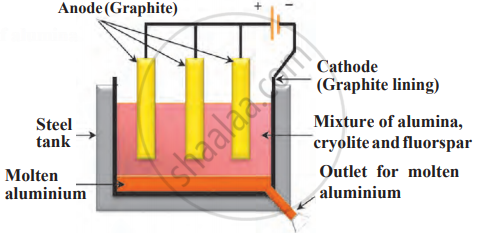
- Name the method.
- Write anode reaction and cathode reaction.
- Why fluorspar and cryolite are added in the mixture?
The process in which a carbonate ore is heated strongly in the absence of air to convert it into metal oxide is called ____________.
The given reaction shows one of the processes to extract the metals like Iron and Manganese.
\[\ce{MnO2(s) + Al(s) -> Mn(l) + Al2O3(s) + Heat}\]
Identify the substance oxidised and reduced in the above reaction.
