Advertisements
Advertisements
Question
Assuming that the charges of an electron is 1.6 × 10⁻¹⁹ coulombs, the number of electrons passing through a section of wire per sec, when the wire carries a current of one ampere is:
Options
0.625 × 10¹⁹
1.6 × 10⁻¹⁹
1.6 × 10¹⁹
0.627 × 10⁻¹⁷
Advertisements
Solution
0.625 × 10¹⁹
Explanation:
Charge = q = e = 1.6 × 10⁻¹⁹ C
Number of electrons = n = ?
Electric current = I = 1A
Time = t = 1S
I = `"q"/"t" = "ne"/"t"`
I = `(1.6xx10^-19xx"n")/1`
`=> "n" = 1/(1.6xx10^-19)`
= 0.625 × 10¹⁹
APPEARS IN
RELATED QUESTIONS
Name the constituents of a cell.
Name the instrument used to control the current in an electric circuit.
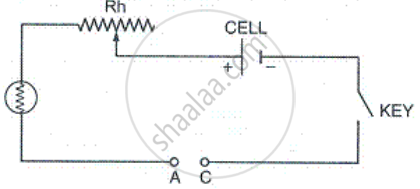
(a) Complete the circuit given in Fig. by inserting between the terminals A and C. an ammeter.
(b) In the diagram, mark the polarity at the terminals of ammeter and indicate clearly the direction of flow of current in the circuit when the circuit is complete.
(c) Name and state the purpose of Rh in the circuit.
There is a positively charged sphere A and negatively charged sphere B, such that they are brought in electrical contact by a copper wire.
Which sphere is at lower potential before electrical contact on the basis of convention?
What do you understand by the term electric current?
How electric current flows in solids?
