Advertisements
Advertisements
Question
Assertion: In the given figure in ΔABC, ∠B = 90° and DE ⊥ BC. AB = 20 cm, AC = 25 cm = CD. BE = 8 cm, then y = 24 cm.
Reason: BC = 15 cm ∴ x = 7 cm.
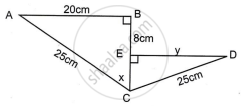
Options
Both A and R are true and R is the correct reason for A.
Both A and R are true but R is the incorrect reason for A.
A is true but R is false.
A is false but R is true.
Advertisements
Solution
Both A and R are true but R is the incorrect reason for A.
Explanation:
Step 1: Verification of Assertion:
Calculation of BC:
In ΔABC, ∠B = 90°.
Given AB = 20 cm and AC = 25 cm
Therefore, 202 + BC2 = 252
400 + BC2 = 625
BC2 = 625 – 400
BC2 = 225
BC = `sqrt(225)`
BC = 15 cm
Calculation of CE:
It is given that CD = 25 cm.
CE = CD – DE. However, DE is not directly given.
Alternatively, CE = BC – DE
Given BE = 8 cm and BC = 15 cm
Therefore, CE = 15 – 8 = 7 cm
Given CD = 25 cm and CE = 7 cm
In ΔCDE, ∠E = 90° .....(since DE ⊥ BC)
By the Pythagorean theorem,
DE2 + CE2 = CD2
DE2 + 72 = 252
DE2 + 49 = 625
DE2 = 625 – 49
DE2 = 576
DE = `sqrt(576)`
DE = 24 cm
Since y = DE, it is found that y = 24 cm
Thus, the assertion is true.
Step 2: Verification of Reason:
Evaluation of BC: As calculated in Step 1, BC = 15 cm.
The reason states BC = 15 cm.
This part of the reason is true.
Step 3: Conclusion on the relationship between Assertion and Reason:
Both the assertion and the reason are found to be true statements.
However, the reason does not provide a correct or complete explanation for the assertion. The calculation of BC is a step in verifying the assertion, but the reason’s conclusion, ∴ 7 cm is vague and does not explain why y = 24 cm.
