Advertisements
Advertisements
Question
Assertion: In ΔABC, AP ⊥ BC. E and F are midpoints of AB and AC, then AQ = QP.
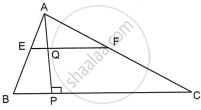
Reason: Q is the midpoint of AP from midpoint theorem.
Options
Both A and R are true and R is the correct reason for A.
Both A and R are true but R is the incorrect reason for A.
A is true but R is false.
A is false but R is true.
Advertisements
Solution
Both A and R are true and R is the correct reason for A.
Explanation:
Assertion:
- Midpoint Theorem Application: In ΔABC, E and F are the midpoints of AC and AB, respectively. The midpoint theorem states that the line segment FE is parallel to BC.
- Altitude and Intersection: The altitude AP is perpendicular to BC and thus AP is parallel to FE. The point Q is the intersection of the altitude AP and the line segment FE.
- Applying the Converse: Consider ΔABP. F is the midpoint of AB. Since FE || BP (because FE || BC), by the converse of the midpoint theorem, the line drawn through F parallel to BP must bisect AP. Therefore, Q, which is on FE and also on AP, is the midpoint of AP.
- Conclusion: Since Q is the midpoint of AP, AQ = QP.
Reason:
The reason states that Q is the midpoint of AP from the midpoint theorem. This is correct because of the steps outlined above.
Assertion (A) is true: AQ = QP is a valid conclusion based on the midpoint theorem and its converse.
Reason (R) is true: Q is indeed the midpoint of AP.
Reason (R) is the correct explanation for (A): The application of the midpoint theorem and its converse to the triangle ABP is the direct reason why AQ = QP.
Therefore, Both A and R are true and R is the correct reason for A.
