Advertisements
Advertisements
Question
Answer the following question:
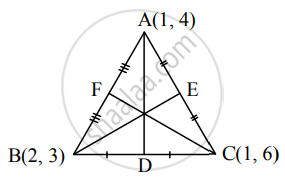
The vertices of a triangle are A(1, 4), B(2, 3) and C(1, 6). Find equations of the medians.
Advertisements
Solution

Let D, E, and F be the midpoints of sides BC, AC, and AB respectively of ΔABC.
Then D ≡ `((2 + 1)/2, (3 + 6)/2) = (3/2, 9/2)`
E ≡ `((1 + 1)/2, (6 + 4)/2)` = (1, 5)
F ≡ `((1 + 2)/2, (4 + 3)/2) = (3/2, 7/2)`
Equation of median AD is
`(y - 4)/(9/2 - 4) = (x - 1)/(3/2 - 1)`
∴ `(y - 4)/(1/2) = (x - 1)/(1/2)`
∴ x – y + 3 = 0
Equation of median BE is
`(y - 3)/(5 - 3) = (x - 2)/(1 - 2)`
∴ – 1(y – 3) = 2(x – 2)
∴ – y + 3 = 2x – 4
∴ 2x + y = 7
Equation of median CF is
`(y - 6)/(7/2 - 6) = (x - 1)/(3/2 - 1)`
∴ `(y - 6)/(-5/2) = (x - 1)/(1/2)`
∴ y – 6 = – 5(x – 1)
∴ 5x + y – 11 = 0
APPEARS IN
RELATED QUESTIONS
Write the equation of the line :
parallel to the X−axis and at a distance of 5 unit form it and above it
Write the equation of the line :
parallel to the X-axis and at a distance of 4 unit form the point (−2, 3)
Obtain the equation of the line :
parallel to the Y−axis and making an intercept of 4 unit on the X−axis
Obtain the equation of the line containing the point :
A(2, – 3) and parallel to the Y−axis
Find the equation of the line passing through the points A(2, 0), and B(3, 4)
Find the x and y intercept of the following line:
`x/3 + y/2` = 1
Find the x and y intercept of the following line:
`(3x)/2 + (2y)/3` = 1
Find the x and y intercept of the following line:
2x − 3y + 12 = 0
Find the equations of perpendicular bisectors of sides of the triangle whose vertices are P(−1, 8), Q(4, −2), and R(−5, −3)
N(3, −4) is the foot of the perpendicular drawn from the origin to line L. Find the equation of line L.
Select the correct option from the given alternatives:
If the point (1, 1) lies on the line passing through the points (a, 0) and (0, b), then `1/"a" + 1/"b"` =
Answer the following question:
Reduce the equation 6x + 3y + 8 = 0 into slope-intercept form. Hence find its slope
Answer the following question:
Obtain the equation of the line containing the point (2, 4) and perpendicular to the Y−axis
Answer the following question:
Find the equation of the line having slope 5 and containing point A(–1, 2).
Answer the following question:
Find the equation of the line through the origin which bisects the portion of the line 3x + 2y = 2 intercepted between the co−ordinate axes.
Answer the following question:
Two lines passing through M(2, 3) intersect each other at an angle of 45°. If slope of one line is 2, find the equation of the other line.
Answer the following question:
Find the Y-intercept of the line whose slope is 4 and which has X intercept 5
Answer the following question:
Find the equations of the diagonals of the rectangle whose sides are contained in the lines x = 8, x = 10, y = 11 and y = 12
Answer the following question:
A(1, 4), B(2, 3) and C(1, 6) are vertices of ∆ABC. Find the equation of the altitude through B and hence find the co-ordinates of the point where this altitude cuts the side AC of ∆ABC.
Answer the following question:
The vertices of ∆PQR are P(2, 1), Q(−2, 3) and R(4, 5). Find the equation of the median through R.
Answer the following question:
The perpendicular from the origin to a line meets it at (−2, 9). Find the equation of the line.
Answer the following question:
Show that there are two lines which pass through A(3, 4) and the sum of whose intercepts is zero.
If (a, −2a), a > 0 is the mid-point of a line segment intercepted between the co-ordinate axes, then the equation of the line is ____________.
If for a plane, the intercepts on the co-ordinate axes are 8, 4, 4, then the length of the perpendicular from the origin to the plane is ______
The slope of normal to the curve x = `sqrt"t"` and y = `"t" - 1/sqrt"t"`at t = 4 is _____.
The intercept of a line between the coordinate axes is divided by the point (1, 3) in the ratio 3 : 1. The equation of the line will be ______
A Plane cuts the coordinate axes X, Y, Z at A, B, C respectively such that the centroid of the Δ ABC is (6, 6, 3). Then the equation of that plane is ______.
The line L given by `x/5+y/b=1` passes through the point (13, 32). The line K is parallel to L and its equation is `x/c+y/3=1`. Then, the distance between L and K is ______.
The angle between the lines x sin 60° + y cos 60° = 5 and x sin 30° + y cos 30° = 7 is ______
Area of the parallelogram formed by the lines y = mx, y = mx + 1, y = nx and y = nx + 1 is equal to ______.