Advertisements
Advertisements
Question
An open metal bucket is in the shape of a frustum of a cone, mounted on a hollow cylindrical base made of the same metallic sheet. The diameters of the two circular ends of the bucket are 45 cm and 25 cm, the total vertical height of the bucket is 40 cm and that of the cylindrical base is 6 cm. Find the area of the metallic sheet used to make the bucket. Also, find the volume of water the bucket can hold, in litres.
Advertisements
Solution
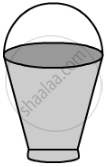
We have,
Radius of the upper end of the furstum, =` "R" = 45/2 "cm"`
Radius of the lower end of the frustum = Radius of the cylinder`="r"="25"/2 "cm"`
Height of the cylinder, = h = 6 m and
Total height of the bucket = 40 cm
And, the height of the frustum, `"l" = sqrt(("R"-r)^2 + H^2`
`=sqrt((45/2 - 25/2)^2+34^2)`
`= sqrt(10^2 + 34^2)`
`=sqrt(100+1156)`
`=sqrt(1256)`
≈ 35.44 cm
Now,
The area of the metallic sheet used to make the bucket = CSA of the frustum + CSA of the cylinder + Area of the base of
`=22/7xx(45/2 + 25/2)xx35.44+2xx22/7xx25/2xx25/2`
`=22/7xx35xx35.44+22/7xx150+22/7xx625/4`
`=22/7xx(1240.4+150+156.25)`
`=22/7xx1546.65`
= 4860.9 cm2
Also,
The volume of the water that the bucket can hold = Volume of the frustum
`=1/3pi"H"("R"^2 + "r"^2+"Rr")`
`=1/3xx22/7xx34xx[(45/2)^2 +(25/2)^2 + (45/2)(25/2)]`
`=748/21xx(2025/4+625/4+1125/4)`
`=748/21xx3775/4`
= 33615.48 cm3
= 33.61548 L (As, 1000 cm3 = 1 L)
≈ 33.61 L
