Advertisements
Advertisements
Question
An object is thrown from Earth in such a way that it reaches a point at infinity with non-zero kinetic energy `["K"."E"("r" = ∞) = 1/2 "Mv"_"∞"^2]`, with what velocity should the object be thrown from Earth?
Advertisements
Solution
An object is thrown up with an initial velocity is vi, So Total energy of the object is
Ei = `1/2"Mv"_"i"^2 - "GMm"_"e"/"R"_"E"`
Now, the object reaches a height with a non-zero K.E.
K.E becomes infinity. P.E becomes zero.
So, Ef = `1/2"Mv"_∞`
Ei = Ef ⇒ vi = V∞
`1/2 "Mv"_∞^2 = 1/2"Mv"_"e"^2 - (2"GMM"_"E")/"R"_"E"`
`1/2 "Mv"_∞^2 = 1/2"M" ["V"_"e"^2 - (2"GM"_"E")/"R"_"E"]`
`"v"_"e"^2 = "v"_∞^2 + 2("GM"_"E"/"R"_"E") "R"_"E"`
= `"v"_∞^2 + 2"gR"_"E"`
ve = `sqrt("v"_∞^2 + 2"gR"_"E")`
APPEARS IN
RELATED QUESTIONS
If the distance between the Earth and Sun were to be doubled from its present value, the number of days in a year would be ___________.
The work done by the Sun’s gravitational force on the Earth is __________.
If the mass and radius of the Earth are both doubled, then the acceleration due to gravity g'
An object of mass 10 kg is hanging on a spring scale which is attached to the roof of a lift. If the lift is in free fall, the reading in the spring scale is ___________.
The work done by Sun on Earth in one year will be
Two bodies of masses m and 4m are placed at a distance of r. Calculate the gravitational potential at a point on the line joining them where the gravitational field is zero.
If the ratio of the orbital distance of two planets `"d"_1/"d"_2` = 2, what is the ratio of gravitational field experienced by these two planets?
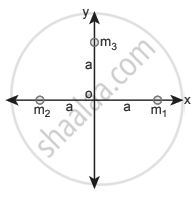
Calculate the gravitational field at point O due to three masses m1, m2 and m3 whose positions are given by the following figure. If the masses m1 and m2 are equal what is the change in a gravitational field at the point O?
What is the gravitational potential energy of the Earth and Sun? The Earth to Sun distance is around 150 million km. The mass of the Earth is 5.9 × 1024 kg and the mass of the Sun is 1.9 × 1030 kg.
Earth revolves around the Sun at 30 km s−1. Calculate the kinetic energy of the Earth. In the previous example, you calculated the potential energy of the Earth. What is the total energy of the Earth in that case? Is the total energy positive? Give reasons.
