Advertisements
Advertisements
Question
An object has moved through a distance. Can it have zero displacement? If yes, support your answer with an example.
Advertisements
Solution
- Yes, an object moving over a distance can experience zero displacement. This occurs when an object's final location matches its beginning position.
- For example, if an object goes from point A to point A, its displacement is zero.
APPEARS IN
RELATED QUESTIONS
Fill in the blank:
Two boys cycling on the road with the same speed are _______ relative to each other.
Fill in the blank using one of the word: at rest, in motion.
A person walking in a compartment of a stationary train is relative to the compartment and is relative to the platform.
A sprinter is running along the circumference of a big sports stadium with constant speed. Which of the following do you think is changing in this case?
Is the following statement correct? If not, modify it suitably to make it correct. "The earth moves round the sun with uniform velocity".
Hi! Friends! Tell me what type of motion. I am in.
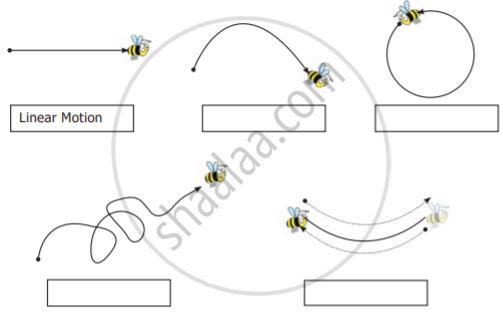
Match the Following.
| Sr. No. | List I | List II | |
| 1. | Motion of a body covering equal distances in equal interval of time | A. | 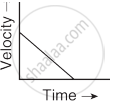 |
| 2. | Motion with non uniform acceleration | B. | 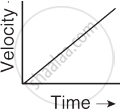 |
| 3. | Constant retardation | C. | 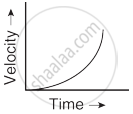 |
| 4. | Uniform acceleration | D. |  |
What is meant by the State of Rest?
A particle is moving in a circular path of radius r. The displacement after half a circle would be:
Given below as figure is the distance-time graph of the motion an object.

- What will be the position of the object at 20s?
- What will be the distance travelled by the object in 12s?
- What is the average speed of the object?
Correct the following.
1 m = 1000 cm
