Advertisements
Advertisements
Question
An isosceles triangle ABC has AC = BC. CD bisects AB at D and ∠CAB = 55°.
Find:
- ∠DCB
- ∠CBD
Sum
Advertisements
Solution
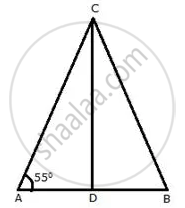
Given:
Triangle ABC is isosceles with AC = BC.
CD bisects AB at D
∠CAB = 55°
Find the remaining angles of triangle ABC
Since AC = BC
∠CAB = ∠CBA = 55°
∠A + ∠B + ∠C = 180°
55° + 55° + ∠C = 180°
∠C = 180° − 110° = 70°
So, ∠ACB = 70°
Since CD bisects AB in an isosceles triangle, it also acts as an angle bisector and median from vertex C.
`∠DCB = 1/2 ∠ACB = 70^\circ/2`
∠DCB = 35°
In triangle CDB:
∠DCB + ∠CBD + ∠CDB = 180°
But since CD is the bisector and △CDB is isosceles (as CD bisects AB),
∠CDB = ∠CBD
35° + 2∠CBD = 180°
2∠CBD = 145°
∠CBD = 72.5°
shaalaa.com
Converse of Isosceles Triangle Theorem
Is there an error in this question or solution?
