Advertisements
Advertisements
Question
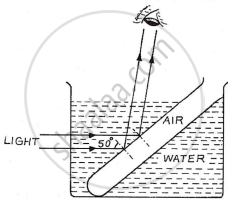
An empty test tube dipped obliquely into water appears silvery when viewed in a suitable direction. Why?
Advertisements
Solution
When a thin glass test tube is placed at an angle of 50° or more with the vertical inside a beaker filled with water and observed from above, its sides appear silvery. This silvery effect arises because light passing through the beaker's sides strikes the inner surface of the test tube at an angle greater than the critical angle for the water-air interface (which is about 49°). At this angle, instead of refracting into the air inside the test tube, the light undergoes total internal reflection back towards the eye. This total internal reflection produces the bright, silvery appearance of the test tube’s surface. However, when water is poured inside the test tube, the water-air interface no longer exists at the inner surface, causing the silvery effect to disappear.
Additionally, the metallic sheen observed on cracks in plate-glass windows when viewed obliquely is due to a similar total internal reflection phenomenon occurring at the cracks.
A similar reasoning applies when a black-sooted ball is immersed in water. The soot traps a thin air layer around the ball, creating a water-air interface where total internal reflection takes place, making the ball appear silvery underwater.
