Advertisements
Advertisements
Question
An air bubble in a glass slab of refractive index 1.5 (near normal incidence) is 5 cm deep when viewed from one surface and 3 cm deep when viewed from the opposite face. The thickness of the slab is ______.
Options
8 cm
10 cm
12 cm
16 cm
Advertisements
Solution
An air bubble in a glass slab of refractive index 1.5 (near normal incidence) is 5 cm deep when viewed from one surface and 3 cm deep when viewed from the opposite face. The thickness of the slab is 12 cm.
Explanation:
Given: Refractive index of glass, μ = 1.5
Apparent depth from one side = 5 cm
Apparent depth from opposite side = 3 cm
Let the actual thickness of the slab be t. When viewed from the top, the apparent depth d1 is related to the real depth by:
d1 = `t/μ`
Similarly, from the bottom:
d2 = `(t - x)/μ`
But in this case, the air bubble is fixed, and the apparent depths seen from both faces are:
`x/μ` = 5 and `(t - x)/μ` = 3
Multiplying both equations by μ:
x = 7.5 cm and t − x = 4.5 cm
Add both:
t = x + (t − x)
= 7.5 + 4.5
= 12 cm
APPEARS IN
RELATED QUESTIONS
The speed of sound in air is 332 m s−1. Is it advisable to define the length 1 m as the distance travelled by sound in 1/332 s?
In the original Fizeau method, the light travelled 8.6 km and then returned. What could be the difficulty if this distance is taken as 8.6 m?
The speeds of red light and yellow light are exactly same
The speed of light is 299, 792, 458 ms−1
(a) with respect to the earth
(b) with respect to the sun
(c) with respect to a train moving on the earth
(d) with respect to a spaceship going in outer space.
Which of the following methods can be used to measure the speed of light in laboratory?
Which of the following methods can be used to measure the speed of light in water?
In an experiment to measure the speed of light by Fizeau's apparatus, following data are used: Distance between the mirrors = 12.0 km,
Number of teeth in the wheel = 180.
Find the minimum angular speed of the wheel for which the image is not seen.
In an experiment with Foucault's apparatus, the various distances used are as follows:
Distance between the rotating and the fixed mirror = 16 m
Distance between the lens and the rotating mirror = 6 m,
Distance between the source and the lens = 2 m.
When the mirror is rotated at a speed of 356 revolutions per second, the image shifts by 0.7 mm. Calculate the speed of light from these data.
A beam of light consisting of red, green and blue is incident on a right-angled prism as shown in figure. The refractive index of the material of the prism for the above red, green and blue colours are 1.39, 1.44 and 1.47 respectively. What are the colours suffer total internal reflection?
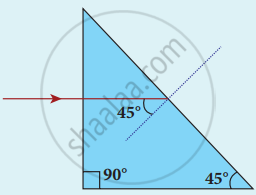
| A ray of light travels from a denser to a rarer medium. After refraction, it bends away from the normal. When we keep increasing the angle of incidence, the angle of refraction also increases till the refracted ray grazes along the interface of two media. The angle of incidence for which it happens is called critical angle. If the angle of incidence is increased further the ray will not emerge and it will be reflected back in the denser medium. This phenomenon is called total internal reflection of light. |
The critical angle of the pair of a medium and air is 30°. The speed of light in the medium is:
