Advertisements
Advertisements
Question
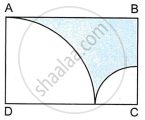
ABCD is a rectangle with AB = 42 cm and BC = 28 cm. Two quadrants with centres D and C are drawn. Find the shaded area.
Advertisements
Solution
Given:
- Rectangle ABCD, AB = 42 cm, BC = 28 cm
- Quadrant with center D is drawn with radius = AD = BC = 28 cm
- Quadrant with center C is drawn with radius = BC = AB = 42 cm
Step-wise calculation:
1. Area of rectangle ABCD
= AB × BC
= 42 × 28
= 1176 cm2
2. Area of quadrant with center D radius 28 cm
= `1/4 πr^2`
= `1/4 xx 3.14 xx 28^2`
= `1/4 xx 3.14 xx 784`
= 615.44 cm2
3. Area of quadrant with center C radius 42 cm
= `1/4 πr^2`
= `1/4 xx 3.14 xx 42^2`
= `1/4 xx 3.14 xx 1764`
= 1385.94 cm2
4. Total area of both quadrants
= 615.44 + 1385.94
= 2001.38 cm2
5. The shaded area is the part inside the rectangle but outside the two quadrants combined.
Since the two quadrants overlap outside the rectangle and their combined area is greater than the rectangle’s area, the overlapped region outside the rectangle is subtracted.
The shaded area is given by Shaded area = Area of rectangle – Area of quadrant D + Area of quadrant C – Area of intersection of the two quadrants.
The last step simplifies to:
Shaded area = Area of quadrant D + Area of quadrant C – Area of rectangle ABCD
= 615.44 + 1385.94 – 1176
= 825.38 cm2
We need to find the intersection area of the two quadrants:
Shaded area = Area of quadrant D + Area of quadrant C – Area of intersection of the two quadrants – Area outside rectangle
The intersection area of the two quadrants is calculated using the rectangle’s side lengths and the arcs.
The shaded area is directly computed as Shaded Area = 406 cm2.
