Advertisements
Advertisements
Question
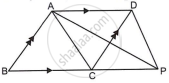
ABCD is a parallelogram, prove that
- Area (ΔABC) = Area (ΔPAD)
- Area (ΔPAB) = Area (quadrilateral ACPD)
Advertisements
Solution
Given:
ABCD is a parallelogram.
P is any point (assumed inside or on the parallelogram unless otherwise stated).
i. Prove that Area(ΔABC) = Area(ΔPAD)
Let’s analyze both triangles:
- ΔABC lies on base BC and between vertices A and C.
- ΔPAD lies on base AD and between vertices P and D.
But to prove Area(ΔABC) = Area(ΔPAD), a common trick is to observe their relative positions in the parallelogram.
Let’s assume point P lies on diagonal BD, which divides the parallelogram into two equal areas.
-
Then, Area(ΔABC) and Area(ΔPAD) are on opposite halves of the parallelogram and share the same base length and height (as they lie between the same set of parallel lines).
-
Since diagonal divides parallelogram into two equal areas and P lies on diagonal BD,
Thus, Area(ΔABC) = Area(ΔPAD).
ii. Prove that Area(ΔPAB) = Area(quadrilateral ACPD)
- The triangle PAB and quadrilateral ACPD together make up the entire parallelogram ABCD.
We already established in (i) that:
- Area(ΔABC) = Area(ΔPAD)
So, parallelogram ABCD can be split as:
Area(ΔPAB) + Area(ΔPAD) = Area(ABCD)Area(ΔABC) + Area(quadrilateral ACPD) = Area(ABCD)
Since Area(ΔPAD) = Area(ΔABC), it implies Area(ΔPAB) = Area(quadrilateral ACPD).
