Advertisements
Advertisements
Question
ABCD is a parallelogram. ∠C = 110°. E is a point on DC so that AD = ED. Find ∠AEC.
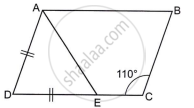
Sum
Advertisements
Solution
Given:
- ABCD is a parallelogram.
- ∠C = 110°.
- E is a point on DC such that AD = ED.
Stepwise calculation:
- Since ABCD is a parallelogram, opposite angles are equal. So ∠A = ∠C = 110°.
- Adjacent angles in a parallelogram sum to 180°, so ∠D = 180° – 110° = 70°.
- Since AD = ED, triangle ADE is isosceles with AD = ED.
- ∠ADE = ∠DEA because of the isosceles triangle property.
- Angle ∠ADC whole angle at D = ∠ADE + ∠EDC = 70° and since ∠EDC = ∠C = 110°, point E lies on DC such that DE = AD.
- To find ∠AEC, we use the exterior angle theorem in triangle AED.
- ∠AEC = 180° – ∠DEA since E, A, C are points in a polygon.
- From the isosceles triangle ADE, calculate ∠ADE and ∠DEA
= `(180^circ - 70^circ)/2`
= 55° - Therefore, ∠AEC = 180° – 55° = 125°.
∠AEC = 125°.
shaalaa.com
Is there an error in this question or solution?
