Advertisements
Advertisements
Question
ABCD is a parallelogram, BC is produced to Q so that ∠DQC = 90°. AP ⊥ DC. If AP = 2.5 cm, BC = 4 cm and DQ = 5 cm, find the length of AB.
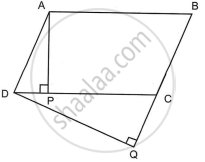
[Hint: Area of || gm = CD × AP = AD × DQ]
Sum
Advertisements
Solution
Given:
- ABCD is a parallelogram
- BC is produced to Q such that ∠DQC = 90°
- AP ⊥ DC, AP = 2.5 cm
- BC = 4 cm
- DQ = 5 cm
To find: Length of AB.
Step 1: Use the hint: Area of parallelogram ABCD = CD × AP = AD × DQ
Step 2: In parallelogram ABCD,
- AB = DC (opposite sides are equal)
- AD = BC (opposite sides are equal)
Step 3: Substitute the known values:
- CD = AB (the side to be found)
- AP = 2.5 cm
- AD = BC = 4 cm
- DQ = 5 cm
Using the area relation:
CD × AP = AD × DQ
⇒ AB × 2.5 = 4 × 5
⇒ AB × 2.5 = 20
⇒ AB = `20/2.5`
⇒ AB = 8 cm
shaalaa.com
Is there an error in this question or solution?
