Advertisements
Advertisements
Question
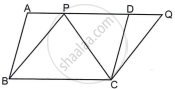
ABCD and PBCQ are parallelograms. Area of ΔPBC = 8 cm2. Calculate the area of parallelograms ABCD, PBCQ and ΔPCQ.
Advertisements
Solution
Given:
- ABCD and PBCQ are parallelograms.
- Area of ΔPBC = 8 cm2.
Since ABCD and PBCQ are parallelograms on the same base BC and between the same parallel lines, their areas are equal. Therefore, Area of parallelogram ABCD = Area of parallelogram PBCQ.
Area of ΔPBC is half of the area of parallelogram PBCQ because the triangle and parallelogram share the same base BC and the same height (between the same parallels). So, Area of PBCQ = 2 × Area of ΔPBC = 2 × 8 = 16 cm2.
Since ABCD and PBCQ have the same area, Area of ABCD = 16 cm2.
To find the area of ΔPCQ: Triangle PCQ shares the base PC with parallelogram PBCQ, and lies between the same parallel lines as PBCQ.
Since PBCQ is a parallelogram, its diagonal PC divides it into two triangles of equal area. Therefore, Area of ΔPCQ = (1/2) × Area of parallelogram PBCQ = `1/2` × 16 = 8 cm2.
Thus,
Area of parallelogram ABCD = 16 cm2.
Area of parallelogram PBCQ = 16 cm2.
Area of ΔPCQ = 8 cm2.
