English

A wooden cubical die is formed by forming hemispherical depressions on each face of the cube such that face 1 has one depression, face 2 has two depressions, and so on. - Mathematics

Advertisements
Advertisements

Question

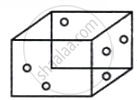
A wooden cubical die is formed by forming hemispherical depressions on each face of the cube such that face 1 has one depression, face 2 has two depressions, and so on. The sum of the number of hemispherical depressions on opposite faces is always 7. If the edge of the cubical die measures 5 cm and each hemispherical depression is of diameter 1.4 cm, find the total surface area of the die so formed.

Sum
Advertisements

Solution

Face 1 = One hemisphere

Face 2 = Two hemispheres

Face 3 − Three hemispheres

Side of cube = 5 cm

Surface area of cube = 6a2

= 6 × 5 × 5

= 150 cm2

Total holes = 1 + 2 + 3 + 4 + 5 + 6

= 21

Radius of hemisphere = `(1.4)/2`

= 0.7 cm

∴ Total number of depressions = 21

Surface area of one hemisphere = 2πr2

Total Surface area of 21 hemispheres = 21 × 2π (0.7)2

= `42 xx 22/7 xx 0.7 xx 0.7`

= 64.68 cm2

The combined area of all the circles removed from the cube = 21 × πr2

= `21 × 22/7 xx 0.7 xx 0.7`
= 32.34 cm2
Total Surface area of the die = Area of the cube + Surface area of the hemisphere − Area of the circle
= 150 + 64.68 − 32.34
= 150 + 32.34
= 182.34 cm2
Hence, the total surface area of the die is 182.34 cm2.
shaalaa.com
  Is there an error in this question or solution?
2024-2025 (March) Standard Official Delhi set 1
Share
Notifications

Englishहिंदीमराठी


      Forgot password?
Use app×